
Natural Resources News
DNR Recognizes Two Anglers with FishMaryland Master Angler Awards
Teen angler and shore fishing specialist are Maryland’s 24th and 25th Master Anglers
 The Maryland Department of Natural Resources has recognized Jesse Black of Kingwood, West Virginia, and Canden Michalski of North East for catching 10 different species of fish at trophy size to reach the FishMaryland Master Angler milestone.
These awardees bring the total number of Master Anglers in the now six-year-old Maryland program to 25.
FishMaryland is Maryland’s recreational fishing recognition program promoting year-round recreational fishing and affordable, accessible, diverse, and high-quality fishing opportunities. More information on the Master Angler Milestone Award and the FishMaryland program is available on the DNR website. Read more…
Maryland’s Early Teal Season Opens September 18

Teal at Millington Wildlife Management Area. Maryland Department of Natural Resources photo.
Maryland’s September teal-only hunting season will be open from Sept. 18 through Sept. 27 in the September Teal Hunting Zone. Shooting hours are one half-hour before sunrise until sunset, the daily bag limit is six teal (blue or green-winged), and the possession limit is 18 teal, or three times the daily bag limit.
Seasons and bag limits for all other migratory game birds can be found in the 2025-26 Maryland Guide to Hunting and Trapping published by the Maryland Department of Natural Resources. Read more…
Secretary’s Message – Maryland is Experiencing a Bivalve Boom

Oysters to be used for restoration are grown at University of Maryland Center for Environmental Science’s Horn Point Laboratory in Oxford. Maryland Department of Natural Resources photo.
Oysters in the Chesapeake Bay are in the midst of a comeback. During the past 20 years, the oyster population in the Maryland portion of the Chesapeake Bay has tripled, according to this year’s stock assessment conducted by the Maryland Department of Natural Resources (DNR) and University of Maryland Center for Environmental Science.
Maryland’s success in bringing back the oyster population is the result of dedicated restoration efforts, favorable environmental conditions, and informed fisheries management.
The good news for oysters is good news for the Chesapeake Bay. Oysters are keystone species in the Chesapeake Bay that support the marine food web, naturally filter water, and create habitats for other species. Read more…
Maryland Greenspace Equity Program Grants Available for Appraisals

Maryland Department of Natural Resources photo
The Maryland Department of Natural Resources (DNR) is now taking applications for Greenspace Equity Program Appraisal Funding Grants, which provide money for independent appraisals for acquisitions that may qualify for an FY 2027 Greenspace Equity Program Grant.
The goal of the Greenspace Equity Program is to preserve, create, and improve public greenspaces that enhance the public health and livability of overburdened and underserved communities. This appraisal funding grant is to help reduce the barrier of upfront costs for qualified land trusts and local governments with limited funds available to spend on appraisals for a potential acquisition project. Applicants selected and approved for appraisal funding must procure and complete the independent appraisals in time to submit an application for the acquisition of the subject property in the upcoming FY 2027 Greenspace Equity Program Grant round, which will be made available shortly. Read more…
Maryland Fishing Report – September 3

Abby Egan went fishing with her dad on the Patuxent River for blue catfish and is all smiles holding one she caught. Photo by S. Egan
Labor Day is now to our stern, but there is still plenty of time to take the kids fishing after school and on the weekends to enjoy the marvelous weather.
Maryland 2025 Black Bear Hunt Lottery Results Announced

Photo by Bob Geary, submitted to the 2018 Maryland DNR Photo Contest.
The Maryland Department of Natural Resources has drawn the winning lottery entries for the 2025 Maryland Black Bear Hunt.
Lottery entrants were randomly selected and will receive a permit valid for the six-day bear hunting season open from October 20-25, 2025 in Allegany, Frederick, Garrett, and Washington counties. Entrants can check the black bear hunt webpage lottery results section for their DNR ID number.
New this year, there will be two black bear hunt zones. Black Bear Hunt Zone 1 comprises Allegany, Frederick, Garrett, and Washington counties, while Zone 2 comprises Frederick and Washington counties. A total of 1,050 entries were drawn between the two black bear hunt zones, with 950 drawn for Black Bear Hunt Zone 1, and 100 drawn for Black Bear Hunt Zone 2. Read more…
New Hydrilla Infestation Detected at Arrowhead Cove in Deep Creek Lake
 The Maryland Department of Natural Resources has recently identified a new location of Hydrilla verticillata, an invasive aquatic plant, near Arrowhead Cove in Deep Creek Lake. This discovery is a significant concern as hydrilla poses a serious threat to the lake’s ecosystem by outcompeting native plant species and disrupting the natural balance of the environment.
Since 2014, the Maryland Park Service Lake Management Office has successfully eradicated Hydrilla from previously affected areas of Deep Creek Lake. The department remains committed to protecting the lake’s health and is already taking action to address this new infestation. The new site will receive an initial treatment and be incorporated into the ongoing management plan. While the four treatment dates for 2025 have already passed, the next scheduled treatment is set for September 10. Further details regarding the management plan and treatment schedule will be shared with the public as soon as they are finalized. Read more…
Maryland Conservation Corps Class of 2024-25 Graduates Following Restoration of Program
Conservation and job training program plans future without federal assistance

Maryland Conservation Corps 2025 graduates together with crew leaders and Department of Natural Resources staff who worked with them through the year. Photo by AJ Metcalf, Maryland DNR
The Maryland Department of Natural Resources honored members of the 2024-25 Maryland Conservation Corps during their graduation program at Sandy Point State Park on Aug. 26. The ceremony capped 10 months of job training, conservation work, and stewardship with the Maryland Park Service.
This year’s class overcame a significant challenge, as they were demobilized in late April after a sudden termination of grant funds by AmeriCorps, the federal program supporting it. DNR reinstated the Maryland Conservation Corps team with state resources until AmeriCorps grants were restored by court order in June.
“I want to extend a heartfelt thank you to every Maryland Conservation Corps member who volunteered their time, stuck with the program, and helped us plan for the future following the unexpected federal cuts to AmeriCorps this year,” Maryland DNR Secretary Josh Kurtz said. “Corps members in Maryland have renovated park facilities, planted trees, restored habitat, led interpretive and educational programs, and improved natural landscapes in every county in Maryland. This year especially, they played a key role in keeping the program running so we can make sure future Conservation Corps classes can continue these important contributions to the state and the Maryland Park Service.” Read more…
‘Women on the Water’ Fishing and Boating Workshop Welcomes Beginner Anglers and Paddlers

Participants getting ready to try fishing at ‘Women on the Water’ event in 2024. Maryland DNR photo.
The Maryland Department of Natural Resources is hosting “Women on the Water,” a free introductory workshop on boating and fishing for women and girls 12 and older, from 4 p.m. to 7 p.m. on Thursday, September 11, at Sandy Point State Park. While designed for women and girls, this program is open to anyone 12 and older.
Registration will open September 4 at 9 a.m. through the “Women on the Water” event page. Participants will receive information about boating opportunities followed by fishing and kayaking instruction in a social, group setting. Department staff will provide fishing gear and teach the basics of fish identification, rigging a rod, and casting techniques.
Following instruction on land, participants can take to the water in a kayak, which will be provided along with required safety equipment. Kayak instructors will teach the basics and guide participants onto Mezick Pond for an evening of paddling and fishing. Participants who prefer to stay ashore can practice casting into the pond. Read more…
Maryland’s 2025 Archery Deer Season Opens September 5
Bowhunting continues through Jan. 31, plus primitive hunt

Photo by Duane Tucker, submitted to the 2016 DNR Photo Contest.
The Maryland Department of Natural Resources will open the archery hunting season for white-tailed and sika deer on Sept. 5. The season runs through Jan. 31, 2026 with several breaks for muzzleloader and firearms season.
In addition, the fourth annual Primitive Deer Hunt Days from Feb. 2 – 4, 2026 offer archers using vertical longbows and vertical recurve bows a few more days afield.
Multiple Sundays are open to archery hunting in most counties, including on some public lands. Hunters should consult the 2025-2026 Maryland Guide to Hunting and Trapping for additional information on specific dates and closures in their region. Read more…
Maryland Fishing Report – August 27

Chris Aaron asked his dad to take him fishing before he headed back to school and it was a good suggestion – here Chris holds up a keeper-sized striped bass he caught in front of Thomas Point Light. Photo by Aaron Beger.
The Labor Day weekend is arriving and the traditional end to summer is upon us. Family vacations usually come to a halt when children head back to school, but there is always time for fishing after school or on weekends.
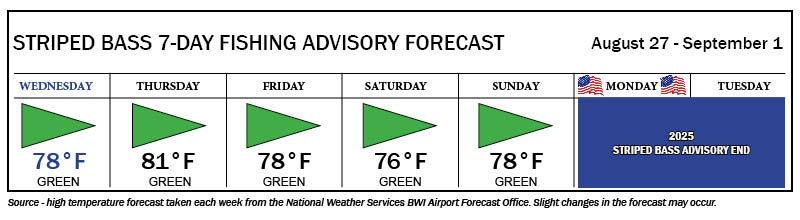
The Department of Natural Resources’ Striped Bass Advisory Forecast also ends for the season this weekend, as the hottest part of the year is typically behind us. For anglers catching any striped bass they intend to keep, DNR encourages you to continue following good catch-and-release practices to help protect this iconic species for future generations to enjoy.
Board of Public Works Approves $13 Million for Community Centers, Playgrounds, and Land Conservation in 16 Counties
Funding approved for DNR’s Program Open Space Local, Local Parks and Playgrounds Infrastructure Program, Community Parks and Playgrounds, and Rural Legacy programs

The Conservation Fund is approved to protect a 121-acre farm that includes more than 1,200 feet of stream buffers along Church Creek in Dorchester County’s Harriet Tubman Rural Legacy Area. This landscape is an area lying largely in and adjacent to the Blackwater National Wildlife Refuge, seen here with Harriet Tubman Underground Railroad State Park in the distance. Maryland DNR photo.
The Board of Public Works today approved $13 million in grants to local governments and land trusts from the Maryland Department of Natural Resources for community centers, playgrounds, and land conservation in Allegany, Baltimore, Caroline, Carroll, Cecil, Charles, Dorchester, Frederick, Garrett, Harford, Kent, Prince George’s, St. Mary’s, Talbot, Washington, and Worcester counties.
About $6.6 million in Program Open Space – Local funding was approved for 12 projects. Prince George’s County was approved for $5.6 million for two projects – to purchase 170 acres to expand Little Paint Branch Stream Valley Park near College Park, and to construct an addition to the Rollingcrest Chillum Community Center in Hyattsville.
Carroll County is also getting funds for six projects including a playground replacement at Piney Run Park and interior renovations at Union Bridge Community Park Community Center. Funding was approved for Talbot County to build a new softball field at Home Run Baker Sports Complex and for Garrett County to renovate existing restrooms and to construct a new dog park at Grantsville Community Park. Read more…
Governor Wes Moore Announces Completion of Maryland’s Five Tributary-Scale Oyster Restoration Sanctuaries
The oyster restoration projects–among the largest in the world–have been highly successful at helping bring back oyster populations and build habitat in the Chesapeake Bay

Maryland Department of Natural Resources Secretary Josh Kurtz, left, added dozens of spat-on-shell oysters to the mark the completion of the Manokin River oyster restoration sanctuary together with Mike Sieracki, Director of the University of Maryland Center for Environmental Science’s Horn Point Laboratory; Allison Colden, Chesapeake Bay Foundation Maryland Executive Director; Angela Sowers, Integrated Water Resource Management Specialist at U.S. Army Corps of Engineers, Baltimore District; and Ward Slacum, Executive Director of the Oyster Recovery Partnership. Photo by Winn Brewer, Maryland DNR.
Governor Wes Moore today announced that Maryland will formally meet its commitment to restore five oyster tributaries in the Chesapeake Bay by completing oyster restoration in the Manokin River Sanctuary on the Lower Eastern Shore. The oyster restoration projects—among the largest in the world—have been highly successful at helping bring back oyster populations, building habitat and supporting economic growth in the Chesapeake Bay.
“This restoration supports our commitment to bringing the oyster population back in five rivers by 2025 and the larger effort to support the repopulation of oysters in the Chesapeake Bay, which has more than tripled in the past 20 years,” said Gov. Moore. “Our success represents the best of government collaboration to systematically address a complex environmental issue with real economic impact.” Read more…
One for the Books: What Does it Take to Land a Maryland Fishing Record?

The Maryland state record common dolphinfish, also known as mahi, was caught Aug. 16, 2019 by Pasadena resident Kristy Frashure (seen here with husband Ryan) during a fishing tournament in Ocean City. She broke a record that had only held three weeks, but before that it had stood for 34 years. Photo by Steve Doctor, Maryland Department of Natural Resources.
Almost any angler would be thrilled to hold claim to a state record title, but few plan on it. A consistent theme among anglers who catch state records is their surprise when they land the fish, often thinking it was another species or even a snag because of the unexpected weight on their line.
While you can’t harness luck, there are steps Maryland anglers can take to increase their chances of hooking the largest fish of a given species in one of four divisions: Atlantic, Chesapeake, Nontidal, and Invasive.
For a record to stick, this fish must be caught legally. This means the angler must hold an active Maryland fishing license (unless exempt) and use legal fishing gear for the waterway they are fishing. Gear rules vary by waterway, season, and species. Brushing up on legal fishing methods is an important step all anglers should take. Rules can be reviewed on the Maryland e-regulations website or in the printed Maryland Guide to Fishing and Crabbing.
With the launch of the new MD Outdoors online licensing system, buying a license, checking its status, and renewing it—which now can be done automatically— is simpler than ever. Read more…
Maryland Begins Migratory Game Bird Hunting Seasons for 2025-2026
Mourning dove, early resident Canada goose seasons begin Sept. 1

Photo by Brian Reidy, submitted to the 2024 Maryland DNR Photo Contest.
The Maryland Department of Natural Resources has announced the state’s 2025-2026 migratory game bird hunting seasons, the first of which begin Sept. 1.
Bag limits, season dates, and shooting hours can be found in the 2025-2026 Maryland Guide to Hunting and Trapping. Read more…
Maryland Department of Natural Resources Proposes Opening State Trails to E-Bikes, Accepting Public Comment Through Sept. 22
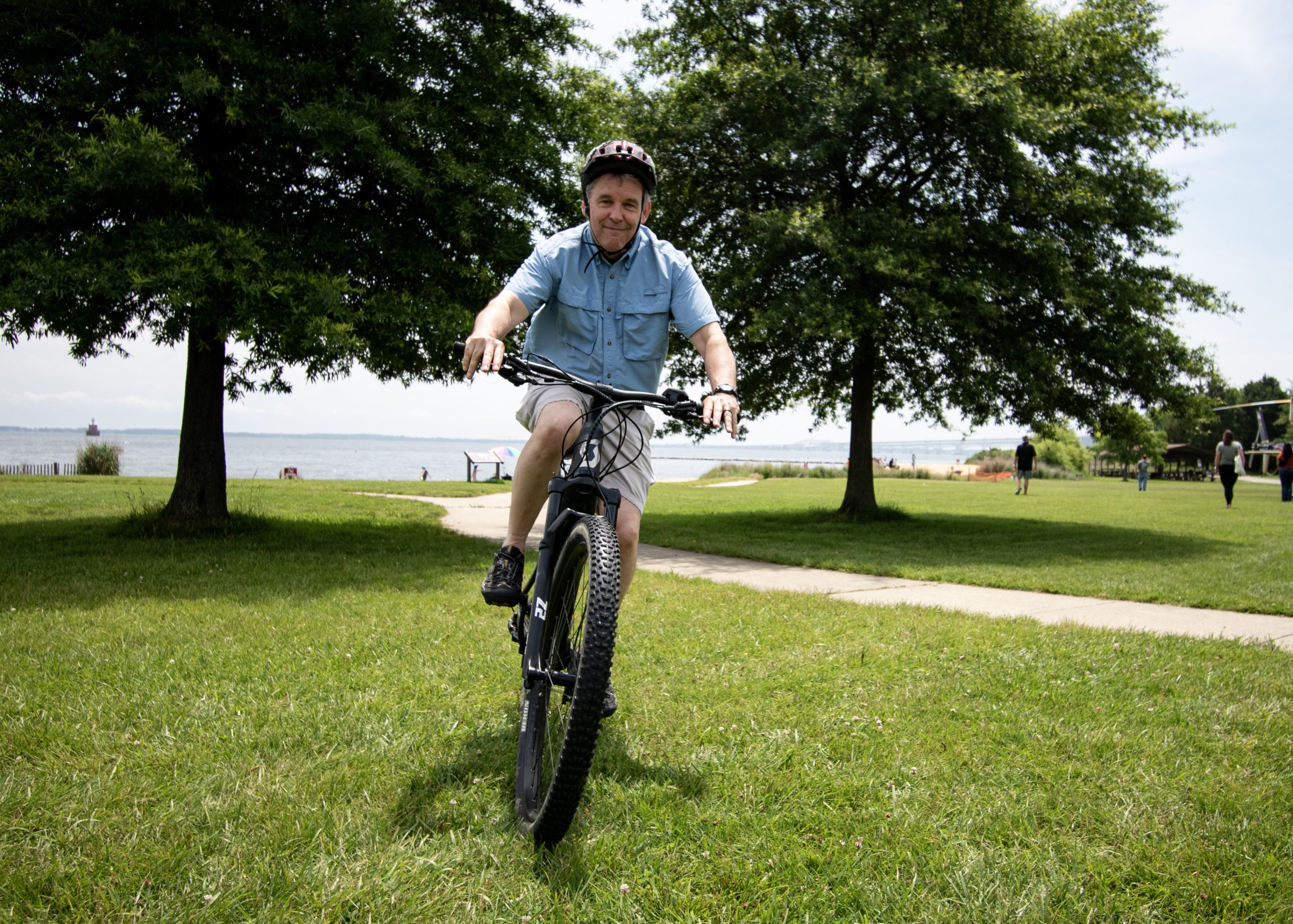
A man tests an e-bike during a Department of Natural Resources event at Sandy Point State Park.
The Maryland Department of Natural Resources is considering new regulations that will allow everyone to use pedal-assist electric bicycles on state bike trails, increasing accessibility and enjoyment of Maryland’s public lands.
For years, all electric bikes have been treated the same as motorized vehicles in parks and public lands, prohibited from traveling on trails and restricted to roads and parking lots. Meanwhile, sales for electric bikes have increased, quadrupling between 2019 and 2022, per the U.S. Department of Energy.
Maryland DNR at the State Fair: Birding, Camping, Fishing, and Other Family-Friendly Activities

A look at displays inside the Mosner Miller Building in 2024 during the Maryland State Fair.
The Maryland Department of Natural Resources and partners will bring displays, exhibits, and fun activities about birds, invasive fish, forestry, camping, hunting, and more to the Maryland State Fair in Timonium.
Fairgoers are invited to visit the exhibits located inside the Mosner Miller Building at the fairgrounds to engage with field experts and learn more about fishing, hunting, wildlife, and recreational opportunities in Maryland’s state forests, parks, and other public lands. Kid-friendly activities include a mini-campsite and coloring corner, as well as kid-friendly presentations. Read more…
Maryland Fishing Report – August 20

Luke Wrye shows what can be found in the deep waters of the Atlantic Ocean with this beautiful golden tilefish caught August 15. Photo courtesy of Luke Wrye.
The coastal areas are seeing heavy surf and higher than normal tides, and perhaps strong winds will occur later this week. It’s a good time to fish in more protected waters or perhaps just stand on the beach and watch nature’s fury.
A reminder to all Maryland anglers, please participate in DNR’s Volunteer Angler Surveys. This allows citizen scientists to contribute valuable data to the monitoring and management of several important fish species.
In particular, striped bass anglers are urged to report their catches and fish they release, which is very helpful to striped bass biologists helping monitor this iconic species.

Three Marylanders Earn Master Angler Recognition in July
 The Maryland Department of Natural Resources has recognized Andrew Reier of Glen Arm, Ryan Kaler of Pasadena, and Jake Prior of Perry Hall for catching 10 different species of trophy-size fish to reach the FishMaryland Master Angler milestone. These three anglers bring the total number of Master Anglers in the program, now in its sixth year, to 23.
FishMaryland is Maryland’s recreational fishing award program promoting year-round recreational fishing and affordable, accessible, diverse, and high-quality fishing opportunities. More information on the Master Angler Milestone Award and the FishMaryland program is available on the program’s website. Read more…
Chesapeake Bay Monitoring Shows Hypoxia Volumes Remained Above Average in July
Dissolved oxygen conditions increased in early July but decreased later in the month
 Data collected by the Maryland Department of Natural Resources and Old Dominion University show an above average volume of hypoxia—waters with less than 2 mg/l of oxygen—in the Chesapeake Bay mainstem of Maryland and Virginia in early and late July.
Early July saw an increase in hypoxia from late June, with volumes almost double the historical average, and the sixth-highest early July volume in the past 40 years. Anoxia – waters with less than 0.2 mg/l oxygen – was also above average.
Hypoxia volumes decreased in late July and were closer to average, but anoxia was near double the historical average and confined solely to Maryland waters. Read more…
Maryland Fishing Report – August 13

Dominic Rizzo proudly holds up a beautiful walleye he caught on the upper Potomac River while fishing with his dad and grandfather. Photo by Dominic Rizzo Jr.
As we approach the halfway mark of August, fitting in a vacation before school starts is often on the mind of parents. Enjoying fishing adventures is a big part of family memories spanning the generations.
With some hot days back in the forecast, remember to take care when catching and releasing any striped bass. Visit the Department of Natural Resources website for tips on catch-and-release fishing, and check the striped bass fishing advisory forecast below to help plan your fishing trip.
How Too Many Deer Are Harming Maryland’s Forests
Overpopulation of deer can reduce a forest’s ability to regenerate

Deer eating at the edge of a forest. Photo by Deepti Bansal Gage, submitted to the 2019 Maryland DNR Photo Contest
Maryland is home to a diversity of native wildlife and plant species, and the balance between the two can sometimes be difficult to manage. Like rabbits overrunning a garden, an overpopulation of deer will have detrimental effects on the undergrowth and vegetation in a forest.
For the Maryland Forest Service, successful stewardship requires finding equilibrium between supporting sustainable woodlands and affording space for the white-tailed deer that reside there. Deer browse on fresh tree buds and leaves that spring up from the forest floor. This is a natural part of their diet, but in the face of shrinking landscapes and fewer hunters, overpopulation of deer is leading to over-browsing.
Since 2005, Maryland’s white-tailed deer population has stabilized around 235,000 deer. This was a stark decrease from the state high of 300,000 in 2002 after growing from an average population of around 150,000 deer in the 1980s until 1993. Meanwhile, the number of licensed hunters in the state has dropped by more than 40% since the 1970s. Since 2010, the white-tailed deer harvest has declined by more than 20%. The combination of less hunters and more deer since the 1980s and 1990s is damaging overall forest health. Read more…
Chesapeake Forest 2025 Hunting Tract Lottery Deadline is Aug. 21

Chesapeake Forest Lands comprise 187 management units totaling more than 76,000 acres in six lower Eastern Shore counties. Maryland Department of Natural Resources photo.
Hunt clubs interested in obtaining a hunting lease agreement on Chesapeake Forest Lands can enter a lottery for available tracts in Wicomico and Worcester counties. The Maryland Department of Natural Resources will accept online entries until August 21, 2025.
The department advises entrants to visit the Chesapeake Forest tracts before making a selection, as some have limited access. Hunt clubs are expected to help maintain access roads, gates, and signs on the leased property. Read more…
Pennsylvania Angler Breaks Maryland Blueline Tilefish Record

Dominic Vuotto of Gilbertsville, Pennsylvania, is the new state record holder for blueline tilefish (Caulolatilus microps) in the Atlantic Division. Photo courtesy Dominic Vuotto.
The Maryland Department of Natural Resources (DNR) has confirmed Dominic Vuotto of Gilbertsville, Pennsylvania, as a new state record holder for blueline tilefish (Caulolatilus microps) in the Atlantic Division.
Vuotto landed a 21.3-pound blueline tilefish July 26 while fishing offshore near Washington Canyon. The outing was Vuotto’s first time fishing.
Vuotto was fishing aboard Foolish Pleasures with charter captain Dale Lisi out of Ocean City. The group was originally trolling for tuna, but after no luck, they stopped to target blueline tilefish at a spot where the captain had found success in the past. The anglers used only hand-crank reels because fish caught with the aid of electric reels are ineligible for state and world records. Read more…
Secretary’s Message – Thrill of the Woods: Maryland’s Bike Trails Offer Challenges for All Skill Levels
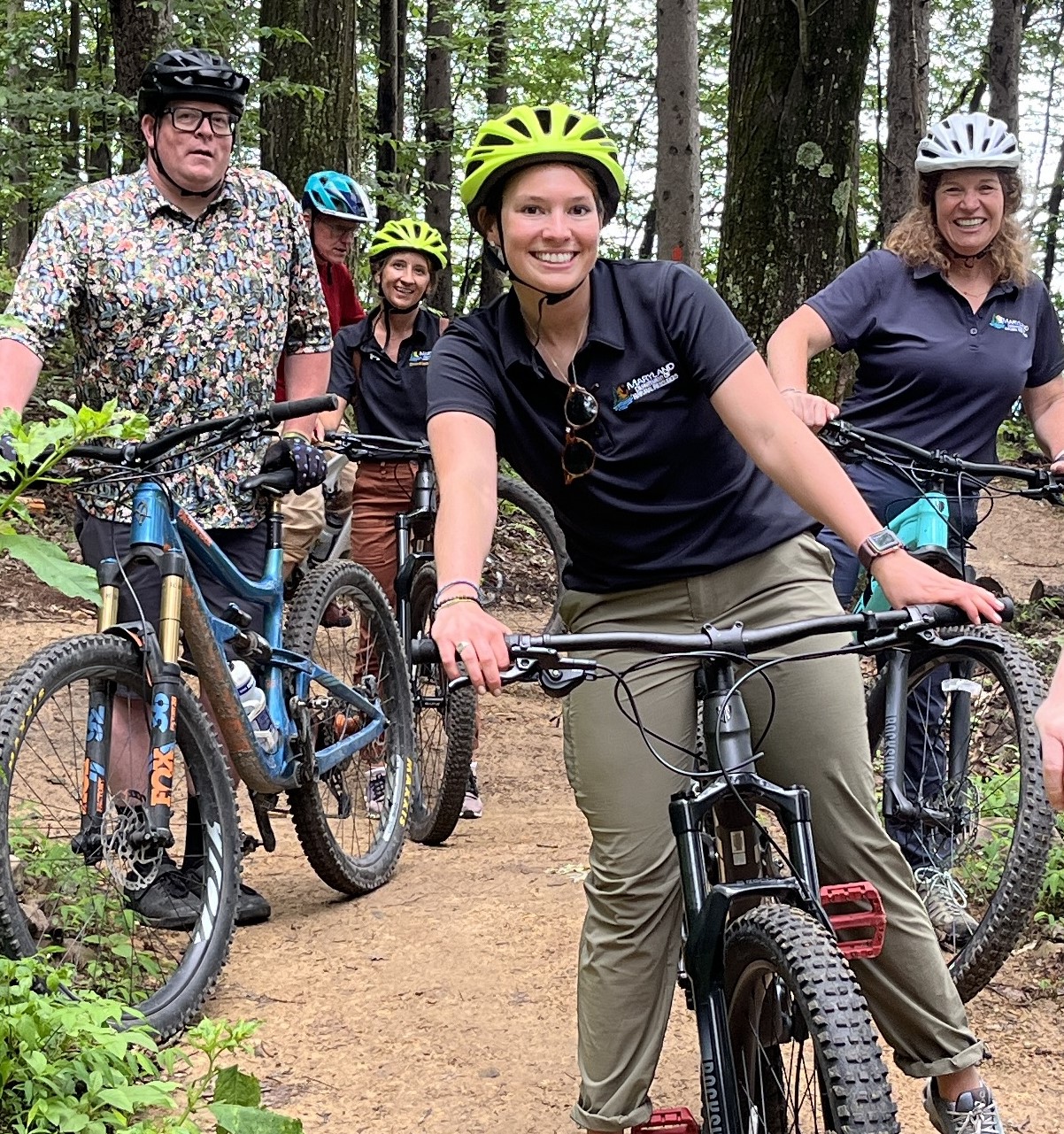
The expanded and updated Margraff Plantation Trail System in Garrett County is a new gem in our state’s mountain bike and hiking network. Maryland Department of Natural Resources photo
The Maryland Department of Natural Resources offers more than 1,400 miles of trails on land and water for all kinds of uses: hiking and running, horseback riding, skiing and snowshoeing, paddling and kayaking, and bicycling.
When the sport of mountain biking rose to prominence in the 1980s, the Maryland Department of Natural Resources embarked on an effort to provide access for the burgeoning sport while assuring the safety of all trail users and minimizing environmental impact.
As a result of that effort and the help of dedicated citizen groups, Maryland today is recognized as a destination for mountain bikers. In 2021, Gambrill State Park and the City of Frederick hosted USA Cycling’s Marathon Mountain Bike National Championships through the scenic and rugged trails of Catoctin Mountain in Frederick County. And proving you don’t need a mountain to go mountain biking, Fair Hill Natural Resource Management Area has since 2023 hosted an annual regional competition for youth riders from around the East Coast, who enjoy our beautiful and challenging course through woods and open fields.
These trails and many others are available to thousands of visitors every year, and the trail network continues to grow – both in size and accessibility. Read more…
Is That Stream Healthy? Here’s How DNR Trains People to Survey Streams By Examining Wildlife and Habitats
The Maryland Biological Stream Survey offers training and certifications at Bowie State University

Maryland Biological Stream Survey scientists demonstrate the process of sampling fish from a stream to a crowd of trainees. Photo by Joe Zimmermann
In some ways, the Maryland Biological Stream Survey Summer Training resembles other education programs. Participants sit through presentations and take tests.
But some of those presentations involve walking through the woods to a nearby stream to watch the process of netting, identifying, and counting fish found there. And studying for the exams involves darting between labs stocked with jars of preserved fish, displays of mussel shells, and tanks for live turtles, snakes, and crayfish.
The Maryland Biological Stream Survey, a Maryland Department of Natural Resources program, holds the training every summer. For the past three years, MBSS has partnered with Bowie State University to conduct the training that takes place in labs, lecture halls, and outdoor areas on the university’s campus. Read more…
Maryland Fishing Report – August 6

Cayla Beam is happy to land her first Chesapeake Channa. Photo by Justin Wilson
The summer fun continues across Maryland, as the White Marlin Open in Ocean City has begun and is attracting anglers from many distant ports. Many anglers are also seeking out more local and satisfying fishing such as Chesapeake Channa, AKA northern snakehead, in the Bay’s tidal rivers this week.
Board of Public Works Approves $2.7 Million for new Ball Fields, Playground Equipment, and Land Conservation in Nine Counties
Funding approved for DNR’s Program Open Space Local, Community Parks and Playgrounds, Greenspace Equity, and Rural Legacy programs

Charles County will receive funds for a 110-acre conservation easement in the Nanjemoy-Mattawoman Rural Legacy Area, protecting habitat for forest interior dwelling species like the barred owl. Photo by Jeff Wetzel, submitted to the Maryland DNR Photo Contest.
The Board of Public Works today approved more than $2.7 million in grants to local governments and land trusts from the Maryland Department of Natural Resources for new ball fields, playground equipment, and the conservation of land in Allegany, Caroline, Carroll, Charles, Dorchester, Montgomery, Prince George’s, Wicomico, and Worcester counties.
More than $900,000 in Program Open Space – Local funding was approved for nine projects, including a Caroline County project to construct a new baseball field, softball field, and small soccer field at Sharp Road Park.
The board approved almost $1.2 million in Community Parks and Playgrounds funding for six projects including to replace outdated playground structures at Fallsgrove Park in Rockville, Wilson Park in Laurel, Woodcock Park in Salisbury, and Northside Park in Ocean City. The Community Parks and Playgrounds program provides funding to municipal governments to restore existing and create new park and recreational facilities throughout the state. This program is currently accepting applications through August 20, 2025.
Also approved was more than $217,000 in Greenspace Equity Program funding for a Prince George’s County project to create a multi-generational growing space and outdoor classroom in Bladensburg. Read more…
Waterfowl Hunting Schedule Set for 2025-26 Season at Deal Island and Fairmount Wildlife Management Area Impoundments

Maryland DNR photo
Hunters can now apply for permits and check the schedule to hunt waterfowl at manmade lakes or ponds, or impoundments, at Deal Island and Fairmount Wildlife Management Areas (WMAs) this season.
Applications for the hunting permits at Fairmount WMA or Deal Island WMA are available on the Maryland DNR website and are due by Sept. 8. All permits for the regular duck season for both the Deal Island and Fairmount WMA impoundments will be issued by lottery conducted in mid-September. Permits will allow the selected hunter and up to two additional guests to hunt on the dates for which they are chosen.
All applicants must have their current Maryland hunting license and applicable stamps, which can be purchased or renewed at the department’s licensing website, MD Outdoors.
The current program is being managed to reduce crowding and maintain the quality of waterfowl hunting opportunities during the regular duck season. Read more…
Maryland Reports Slight Loss in Underwater Grass Abundance in Chesapeake Bay for 2024

A mix of wild celery (Vallisneria americana) and water stargrass (Heteranthera dubia), both freshwater underwater grasses. Photo by Brooke Landry, Maryland Department of Natural Resources.
Underwater grass abundance in Maryland’s portion of the Chesapeake Bay – a key indicator of water quality – fell from 38,188 acres in 2023 to 36,794 acres in 2024, according to data reviewed by the Maryland Department of Natural Resources. This acreage remains short of the state’s 2025 restoration goal of 79,800 acres.
The annual survey of submerged aquatic vegetation (SAV) was conducted by the Virginia Institute of Marine Science between May and October 2024. The Bay was fully mapped in 2024.
In Maryland, despite an overall loss of underwater grass acreage, freshwater SAV populations did well in 2024 and all or part of five rivers surpassed their restoration goals. Read more…
Maryland Department of Natural Resources Introduces New ‘MD Outdoors’ App
Part of upgraded licensing system, new app replaces AccessDNR

Maryland DNR photo by Natalie Kolb.
The Maryland Department of Natural Resources is introducing a new free mobile app – MD Outdoors – which will be the official app for the state’s outdoor enthusiasts, hunters, and anglers.
The MD Outdoors app replaces the AccessDNR app, which will no longer be supported. Users will need to remove the old app and download an updated version from the DNR website.
The new MD Outdoors licensing system went online in June for residents and visitors to purchase Maryland hunting and fishing licenses as well as associated stamps and permits, boat and off-road vehicle renewal registration, and other services. The new MD Outdoors app can also be used to display an individual’s hunting or fishing license as well as boating or off-road vehicle registrations when needed. Read more…
Shooting Qualification Sessions Available for Maryland Hunters
Proficiency test is required to participate in certain managed deer hunts

Maryland Department of Natural Resources photo
The Maryland Department of Natural Resources has posted its schedule of shooter qualification sessions for the 2025 season, with more than 20 sessions at 10 locations across the state from June through December. These events allow hunters to take the necessary proficiency test required to obtain a Shooter Qualification Card in order to participate in many of the state’s managed deer hunts scheduled in the fall and winter. Additional sessions may be available upon reservation. Read more…
Natural Resources Police Attending National Night Out Community Outreach Events in 19 Maryland Counties

NRP officers join forces with the community – and The Oriole Bird – at a 2024 National Night Out event in White Marsh. Maryland DNR photo.
Maryland Natural Resources Police officers will visit communities throughout Maryland on Tuesday, Aug. 5 in support of National Night Out, an annual community-building campaign promoting partnerships between the police and the neighborhoods they serve.
The National Night Out campaign was established in 1984 and has grown to include more than a million community members in all 50 states. Maryland’s community events include block parties, festivals, parades, cookouts, and public safety demonstrations. Read more…
Chasing a Slippery Predator: Eight Places to Target Maryland’s Chesapeake Channa
Invasive Chesapeake Channa can be found in most of the Chesapeake’s tributaries

The toothy, slimy Chesapeake Channa isn’t native to our waters, but many Maryland anglers have a sense of pride in fishing for them. Maryland DNR photo.
The Chesapeake Channa, or snakehead, has developed a dedicated following in the sportfishing community–even though they’ve been an unwelcome addition to Maryland waterways.
These invasive predators known primarily as snakeheads were coined Chesapeake Channa by the Maryland General Assembly in 2024.
Whatever you call this fish, Maryland Department of Natural Resources (DNR) fisheries biologists and avid anglers have seen populations of Channa in Maryland grow since their arrival in 2002. They have spread rapidly through the Potomac River watershed and established a strong presence in nearly every tributary of the Chesapeake Bay. Though they are considered a freshwater fish, Chesapeake Channa can tolerate moderate salinity and have been observed in the saltiest parts of the Chesapeake Bay, where rates range from 10% to 12%. Decreases in salinity from heavy rainfall and flooding increases dispersal of the species, enabling the fish to spread from rivermouths to the Bay’s mainstem, and into nearby rivers. Read more…
Microfishing in Maryland: A Tiny Trend or Growing Hobby?
Survey of Maryland anglers shows interest in microfishing
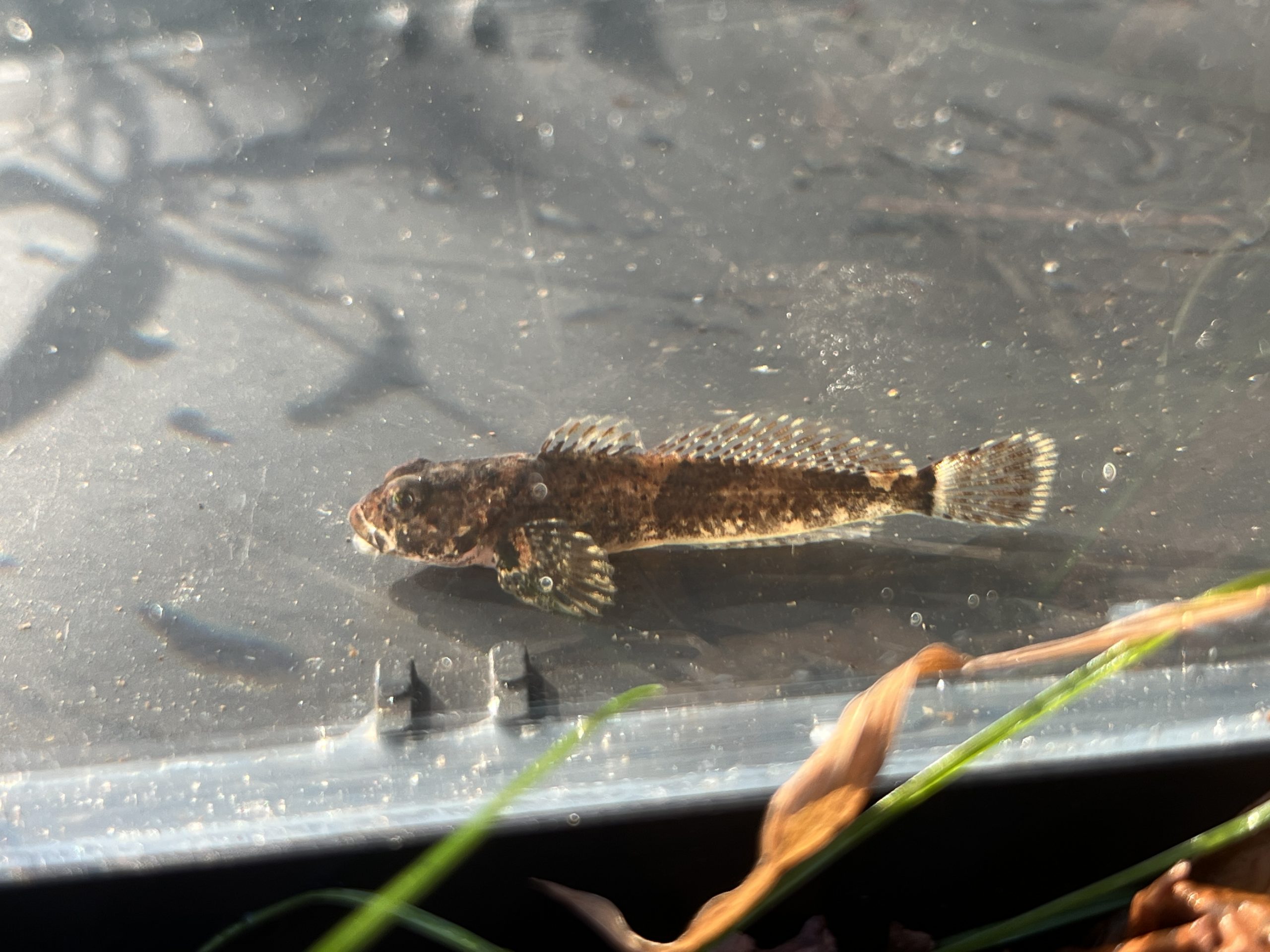
The blue ridge sculpin is among the species Marlylanders can target in microfishing. Photo by Peter Didden, submitted to Maryland Department of Natural Resources’ Angler’s Log.
When most people think about fishing, they envision a proud angler holding a trophy-sized bass for an attention-grabbing photo of a personal best catch. But a type of fishing with the opposite approach has been gaining traction in recent years—microfishing.
As the name implies, anglers use a hook and line to target small-bodied fish that most people would consider minnows or baitfish.
The sport has received considerable media attention and social media buzz. Stories highlight the sport’s specialized tackle, such as tiny hooks, and microfishing’s focus on native fish species diversity. Despite the increase in visibility, very little is known about angler attitudes and knowledge of microfishing in Maryland.
To learn more, the Maryland Department of Natural Resources (DNR) Fishing and Boating Services conducted a survey of Maryland freshwater fishing license holders in May 2025. The goal of the survey was to gather baseline information about this emerging user group in Maryland. Anglers were asked questions about their personal experience with microfishing, such as how often they participate and their primary motivations. The survey also captured perspectives from those who had never microfished. Read more…
Maryland Fishing Report – July 30

Angler Chhaya Muth caught and released a 37.5-inch red drum in the Chesapeake Bay. Photo courtesy of Chhaya Muth
It may be hot out but there is plenty of great fishing to be had throughout Maryland. Be sure to pack some fishing gear or charter a fishing trip and make some lasting family memories.
The 2025 striped bass season will reopen in Maryland’s portion of the Chesapeake Bay this coming Friday, August 1. Once the season begins, anglers are urged to use the best catch-and-release practices since water temperatures in the Bay are in the upper 80s and very stressful for striped bass. Fish should be brought in as quickly as possible and released in the water if they are above or below the required slot size of 19-24 inches. The larger fish most often have a more difficult time with heat stress.
Frederick County Angler Sets New Maryland State Record for False Albacore
New state mark for species set just eight days after 30-year-old record fell

Jack Dorman broke the Maryland state record for false albacore on July 20, 2025. Photo courtesy of Jack Dorman, used with permission by Maryland DNR.
The Maryland Department of Natural Resources has officially recognized Jack Dorman of Mt. Airy as the new state record holder for false albacore (Euthynnus alletteratus) in the Atlantic Division. Dorman’s 26.0-pound catch surpasses the previous record of 23.5 pounds that was just set earlier this month. Read more…
Public Input Sought for Next Chapter of Chesapeake Bay Restoration Work

Photo by Robert Fawcett, submitted to the 2021 Maryland DNR Photo Contest.
On Tuesday, August 5, Maryland will host an open house in Annapolis to provide information for the public about the recently released draft revisions to the Chesapeake Bay Watershed Agreement.
The Agreement is the voluntary plan – signed by Maryland, New York, Delaware, Virginia, Pennsylvania, Washington, D.C., the Chesapeake Bay Commission, and the U.S. Environmental Protection Agency – that details priorities to restore the Chesapeake Bay for the benefit of communities across the region.
Experts from Maryland state agencies will be available to explain the proposed revisions to the Bay Agreement and answer questions that attendees may have. There will also be an opportunity for the public to submit their thoughts on the revisions as part of the public feedback period, which runs until September 1. Read more…
Maryland Fishing Report – July 23

Jake Prior holds up a big Chesapeake Channa he caught recently. Photo courtesy of Jake Prior
Marylanders are out enjoying the outdoors as we find ourselves in the peak of the summer vacation season. Anglers are finding good fishing in the tidal rivers for Chesapeake Channa.
Anglers fishing the Chesapeake Bay and its tributaries are reminded that all fishing and targeting of striped bass is closed from July 16 through July 31. Striped bass fishing resumes Aug. 1 through Dec. 10 with a slot size of 19-24 inches and a limit of one fish per day per angler.
Maryland Waterway Improvement Fund Provides $20 Million in Capital Grants for Public Boating Access, Navigable Waterways and Safety

Oak Creek Landing public “soft launch” boat access in Talbot County was upgraded using a previous Waterway Improvement Fund grant. Maryland Department of Natural Resources photo.
The Maryland Department of Natural Resources will provide $20 million in Waterway Improvement Fund allocations to communities and projects throughout Maryland in Fiscal Year 2026, which begins July 1. The funds will support new and improved public boating access facilities, dredging of navigable public waterways; emergency vessels and equipment for local first responders; and other important infrastructure and initiatives. Read more…
Deadline is Approaching for Maryland DNR 2025 Photo Contest

Photographer Amy Dossett’s photo of a great horned-owl was voted fan favorite in Maryland DNR’s 2023 photo contest.
Photographers and nature enthusiasts have until August 1 to submit their most beautiful images of the state’s flora and fauna to the Maryland Department of Natural Resources 2025 Photo Contest.
As in past years, winning entries will be featured on the next Maryland DNR nature calendar to be published in late fall, and all winners will receive free copies. The contest is judged by season: winter, spring, summer, and fall. First, second, and third place winners are selected for each seasonal category. A grand prize winner is selected from that group. Cash awards are $700 for the grand prize winner, and $100 for each seasonal first place winner. All first place winners receive a one-year Maryland State Park and Trail Passport. Read more…
New Margraff Trail System in Western Maryland Offers Easy, Intermediate, Advanced and Adaptive Options for Hikers and Bikers
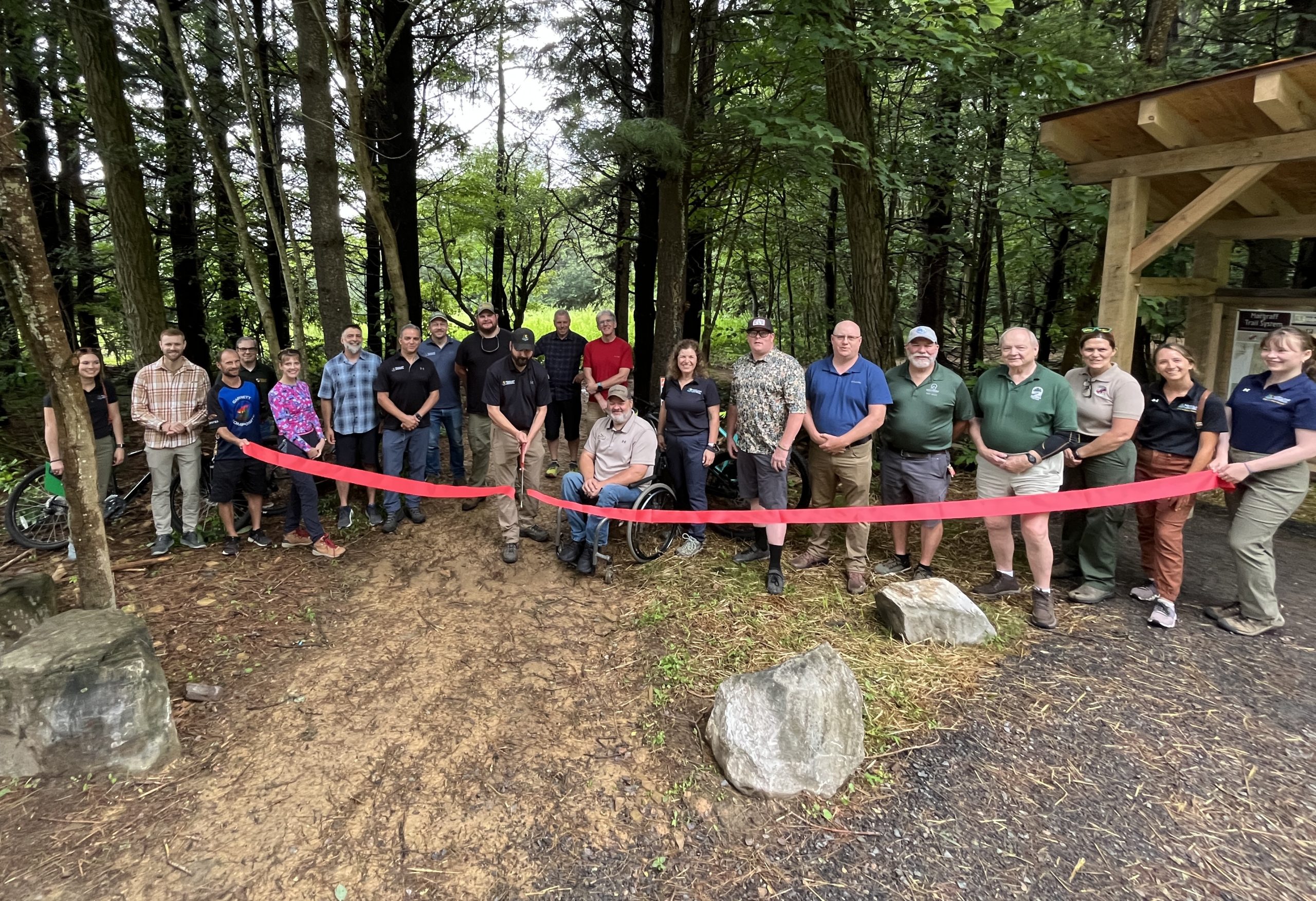
Maryland Department of Natural Resources Sec. Josh Kurtz cut the ribbon on the newly expanded 10-mile trail system in Garrett County on July 18.
Maryland is celebrating the creation of four brand-new mountain bike trails in Savage River State Forest, including the first adaptive mountain bike trail on state forestlands.
Tucked in the mountains of Western Maryland near Accident in Garrett County, the Margraff Plantation Trail System offers six miles of newly-constructed trails – a 1.4-mile beginner trail, a 1.4-mile intermediate trail, a 1.2-mile advanced trail and a 2-mile intermediate-level adaptive trail.
The interconnected trail system gives both riders and hikers the chance to try out varied terrain and progress in skills and challenges, depending on how they feel. Trail users will enjoy traversing through diverse habitats, including pine and deciduous forests, as well as mountain laurel and meadow landscapes.
North Carolina Angler Breaks Maryland’s 30-year-old False Albacore State Record

The new state record false albacore is weighed at Ocean City Fishing Center (left and center); record-holder Timothy K. Shaarda of Clayton, North Carolina, is seen at right holding a different fish. Photos courtesy Timothy Shaarda, collage by Maryland Department of Natural Resources.
The Maryland Department of Natural Resources recognizes Timothy K. Shaarda of Clayton, North Carolina, as a new state record holder for false albacore (Euthynnus alletteratus) in the Atlantic Division. Shaarda’s 23.5-pound catch breaks a record that had stood for 30 years. Read more…
Chesapeake Bay Monitoring Shows Hypoxia Increased in June After Rainy May
Dissolved oxygen conditions show mixed results in May and June 2025
 Data collected by the Maryland Department of Natural Resources and Old Dominion University show an increasing volume of hypoxia—waters with less than 2 mg/l of oxygen—in the Chesapeake Bay mainstem of Maryland and Virginia from early to late June.
No hypoxia was observed in May, marking a later start to low dissolved oxygen conditions than in recent years. This year was one of nine years with no monitored hypoxia in May during the past 41 years.
Hypoxia increased from below average levels in early June to above average in late June following heavy rains in May and hot temperatures during June. Historically, heavy rainfall early in the year can precede greater levels of hypoxia–areas of water with low dissolved oxygen levels–due to rain runoff carrying excess nutrients into the Bay, which can contribute to algal blooms and reduce water clarity.
Late June had the largest historical volume of hypoxia seen within Maryland for the time period of the monitoring program. Both June monitoring cruises showed a greater than average volume of anoxia – waters with less than 0.2 mg/l oxygen – with late June reaching triple the normal average. Read more…
Maryland Fishing Report – July 16

Joseph Pfister was fishing in an upper Chesapeake Bay tidal river when he caught this big Chesapeake Channa, aka northern snakehead. Photo courtesy of Joseph Pfister
We’re in the peak of summer and people across Maryland can be seen traveling the roads for family vacation destinations. For many, fishing and enjoying the outdoors will be part of the fun, and with school out our younger anglers get to indulge in fishing.
Anglers fishing the Chesapeake Bay and its tributaries are reminded that all fishing and targeting of striped bass is closed from July 16 through July 31. Striped bass fishing resumes Aug. 1 through Dec. 10 with a slot size of 19-24 inches and a limit of one fish per day per angler.
Maryland Opens Grants Gateway to Solicit Proposals to Help Fund Programs and Projects Focused on Watershed Restoration, Climate Resilience, Boating Access, and Education
Maryland DNR now accepting grant applications for Fiscal Year 2027

Funds provided through DNR’s Grants Gateway portal helped restore Lake Marion in Anne Arundel County, which now drains more than 113 acres of impervious surface in the Severn River watershed among other benefits. Maryland DNR photo.
The Maryland Department of Natural Resources’ Grants Gateway application is open for local governments and organizations for Fiscal Year 2027, which begins July 1, 2026.
Through this process, DNR connects Maryland communities with funding for projects and programs that improve water quality in local waterways, increase communities’ resilience to storms and climate change, strengthen local economies, develop environmental stewards, and benefit the general boating public. Read more…
Board of Public Works Approves $1.4 Million for Outdoor Recreation and Land Conservation in Prince George’s and Frederick Counties, Southern Maryland, and the Eastern Shore
Funding approved for DNR’s Program Open Space Local, Local Parks and Playgrounds Infrastructure, Community Parks and Playgrounds, and Rural Legacy programs

Located on the northern end of St. Mary’s County, the Huntersville Rural Legacy Area includes 12 miles of Patuxent River. The Patuxent Tidewater Land Trust will acquire an 84-acre easement to protect 2,500 feet of forested stream buffers along tributaries to Little Cat Creek, which flows into the river. Maryland DNR photo.
The Board of Public Works today approved more than $1.4 million in grants to local governments and land trusts from the Maryland Department of Natural Resources. The funding will be used for a new trail, playground equipment, and the conservation of land in Charles, Frederick, Prince George’s, Queen Anne’s, St. Mary’s, and Worcester Counties. Read more…
Maryland’s Summer Closure of Chesapeake Bay Striped Bass Fishing Begins July 16
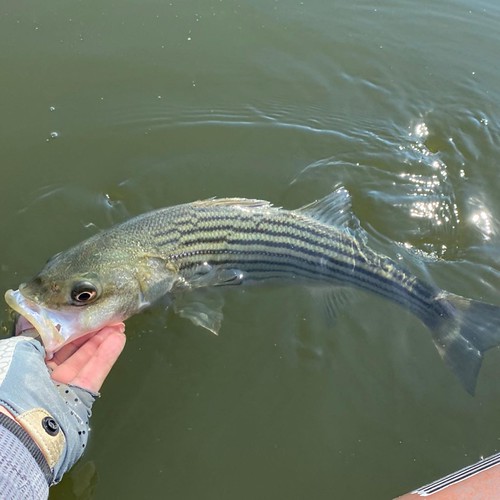
Anglers who accidentally catch a striped bass during the summer closure should release it immediately in the water. Maryland Department of Natural Resources photo by Eric Packard.
The Department of Natural Resources reminds Maryland recreational anglers that targeting striped bass in the Chesapeake Bay and its tidal tributaries is prohibited from July 16 through July 31.
This closure, now in its sixth season, is necessary to protect the species, because when water and air temperatures rise in the hottest part of summer, fish are more vulnerable to dying after being caught and released. Read more…
Maryland Department of Natural Resources Introduces Planning Tool to Enhance Coastal Flood Preparedness around the State
The Maryland Coastal Flood Explorer gives planners and decision makers access to the most current coastal flood data

Flooding in Annapolis in 2023. Photo submitted to Maryland DNR MyCoast app.
Maryland coastal residents can now explore local coastal flooding risks today and into the future. This month, the Maryland Department of Natural Resources released the Maryland Coastal Flood Explorer, a user-friendly and interactive mapper that allows users to visualize predicted high tide flooding, sea-level rise projections, and historic flooding events for all of Maryland’s coastal areas.
Any resident can go to the Flood Explorer, enter an address, and explore various flood risk scenarios around their property as well as within their broader community. Read more…
Hunters Can Now Apply for the 2025 Maryland Black Bear Hunt Lottery

Photo by Nathaniel Peck, submitted to the 2023 Maryland DNR Photo Contest.
Hunters can now enter the lottery selection process for the annual six-day black bear hunt in Western Maryland. The cost to enter the lottery is $15 and applications can be purchased from the Maryland Department of Natural Resources (DNR) through August 31.
The 2025 bear hunting season will be open October 20-25 in all of Allegany, Frederick, Garrett and Washington counties. The bear hunt is an important part of managing Maryland’s expanding bear population, helping reduce conflicts between bears and humans such as collisions with vehicles and property damage.
Hunters who have entered multiple years in a row receive “preference points,” one additional entry for each consecutive year they have applied. Anyone who is not seeking a permit this year but may in the future can purchase a preference point for $15 – they will not be entered in the 2025 lottery, but will not lose their advantage for next year.
New for 2025, hunters may choose to enter a secondary lottery to hunt in Frederick and Washington counties if not drawn in the primary lottery. If a hunter opts into the secondary lottery, their preference points will be applied. The additional hunting opportunity is open to all applicants, but the permit is only valid in Frederick and Washington counties. Read more…