
MDEM Newsroom - Page 20 MDEM Newsroom
As MEMA Monitors Hurricane Irma, Residents Should Prepare
September 7th, 2017As MEMA Monitors Hurricane Irma, Residents Should Prepare
REISTERSTOWN, Md. (September 7, 2017) — The Maryland Emergency Management Agency (MEMA) continues to monitor Hurricane Irma and additional tropical weather systems in the Atlantic. While it is still too early to know what impacts, if any, that Irma may have on Maryland next week, residents should prepare now.
“I urge all Marylanders to prepare now for the potential effects of Hurricane Irma,” said Governor Larry Hogan. “While we have the benefit of time, review your family emergency plans and ensure you have supplies on hand. As always, Maryland stands ready to support our friends and neighbors in states that will be dealing with the impacts from this major hurricane first.”
In addition to continuous communication with the National Weather Service, MEMA is coordinating with local emergency management offices and state partners to ensure that they have the information and resources they need to respond.
“Hurricane tracks can shift quickly,” said Russ Strickland, Executive Director of MEMA. “Everyone in our area should regularly check forecasts, build an emergency kit, and always listen to the directions of local officials.”
Before a storm, residents and visitors in Maryland can:
- Prepare an emergency kit and create a family communications plan. Good supplies to have on hand include bottled water and non-perishable food, a battery-operated radio, flashlight, extra batteries, toiletries, and copies of important documents.
- Check to see if you are in a flood-prone area on our website: mema.maryland.gov.
- Communicate with friends, family members, and neighbors and make sure that they are up to date with the latest information and weather forecast.
MEMA Reminds Marylanders that September is National and Maryland Preparedness Month
September 1st, 2017Click here to listen to this press release.
In the wake of Hurricane Harvey, Governor Larry Hogan and the Maryland Emergency Management Agency (MEMA) are reminding Marylanders that September is both National and Maryland Preparedness Month. Throughout the month, state officials are urging all residents to review preparedness information for severe weather and other emergencies. In an effort to promote preparedness, Maryland’s government agencies, businesses, community groups, schools, and families will participate in events around the state.
“Preparing for an emergency before it happens can make a huge difference both in our homes and our communities,” said Governor Hogan. “This month is a reminder that the time to prepare is now and that all Marylanders must work together and help each other during weather-related emergencies and other hazardous situations.”
Common hazards in Maryland include flooding, high wind, severe thunderstorms, and winter storms. Several online sources provide good emergency preparedness information for these and additional threats including:
- Maryland Emergency Management Agency Website
- Federal Emergency Management Agency: www.ready.gov
- National Weather Service
During Preparedness Month, MEMA will be announcing events and information throughout September on our Twitter feed @MDMEMA, Facebook page and Instagram.
“The devastating effects of Hurricane Harvey should remind us that we all need to be prepared for emergencies,” said Russ Strickland, Executive Director of MEMA. “Right now we are in the height of the hurricane season in the mid-Atlantic, but we also need to be ready for a variety of other threats. Now is the time to make sure you are prepared.”
Governor Hogan Makes Ceremonial Call On “Maryland FiRST” Marking Completion Of The Third Phase Of New Statewide 700 MHz Radio System
August 3rd, 2017Governor Hogan Makes Ceremonial Call On “Maryland FiRST” Marking Completion Of The Third Phase Of New Statewide 700 MHz Radio System
Click here to read the press release from the Maryland State Police
Maryland Awarded $2 Million in Grants to Prepare for Terrorist Attacks
July 13th, 2017Maryland Awarded $2 Million in Grants to Prepare for Terrorist Attacks
REISTERSTOWN, Md. (July 13, 2017) — The Maryland Emergency Management Agency (MEMA) has been awarded $2,098,575 in order to prepare the State and local communities for terrorist attacks. The award, announced earlier today by the U.S. Department of Homeland Security, is part of the Complex Coordinated Terrorist Attack Program, which will provide $35.94 million to selected recipients to improve their ability to prepare for, prevent and respond to complex coordinated terrorist attacks. MEMA is one of only 29 successful applicants nationwide for this competitive grant.
“The safety of Maryland and the protection of our citizens is a top priority,” Governor Larry Hogan said. “These funds will enable our state to incorporate a comprehensive approach to preparing for and responding to the threat of terrorism into our emergency management system.”
This grant will fund capability building at the state and local government level by enhancing planning, training and exercising for terrorist attacks and improving emergency managers’ response.
According to the Federal Emergency Management Agency, terrorist incidents, such as those in London, England; Boston, Massachusetts; Nairobi, Kenya; San Bernardino, California; Paris, France; and Brussels, Belgium; highlight an emerging threat known as complex coordinated terrorist attacks.
“Recent history has shown that we need to prepare for a wide range of incidents and even violent attacks,” said MEMA Executive Director Russ Strickland. “This grant and the associated work will help ensure that Maryland continues to be a leader in consequence management and risk reduction.”
Summer Season Brings Possible Hurricane Dangers to Maryland
May 8th, 2017NOW IS THE TIME TO PREPARE: MAY 7-13 IS HURRICANE PREPAREDNESS WEEK
REISTERSTOWN, Md. (May 8, 2017) — This week is Maryland Hurricane Preparedness Week and the Maryland Emergency Management Agency (MEMA) is teaming up with the National Weather Service (NWS) and local emergency managers to promote citizen awareness and preparedness.
The Atlantic hurricane season runs from June to November. The height of our season in Maryland typically is mid-August to October. Hurricanes can cause strong winds, heavy rain, inland flooding and other severe weather. Residents in Maryland can “be weather ready” by ensuring that they know how to receive a warning, have a plan, and practice safety tips.
“Now is the time to start planning for hurricanes,” said Governor Larry Hogan. “Make sure you have an emergency plan, a disaster supply kit ready, and that your family, friends, and neighbors are prepared as well. If a storm is headed our way, the safest action is the simplest action – use common sense and stay safe.”
“We all saw the destruction in North Carolina and other states to our south after Hurricane Matthew last summer,” said MEMA Executive Director Russ Strickland. “Just a slight change in the path of that storm and Maryland could have been in the bull’s eye. Don’t wait until a storm is headed our way to prepare.”
The NWS notes Maryland can see hurricanes and impacts from a storm hundreds of miles away. “Damage to coastlines and destruction several hundred miles in-land can be seen with these tropical storms,” said NWS Warning Coordination Meteorologist Christopher Strong. “Hurricanes can produce 150-plus miles per hour winds, tornadoes and tremendous flooding from both tidal surges as well as torrential rain.”
The NWS and MEMA work closely together and with local government agencies to identify and monitor hurricane activity, develop preparedness plans and safety information and coordinate the response to these storms.
Residents can also take actions now to remain safe by taking the following actions:
- Build an emergency supply kit and develop a family emergency and communications plan.
- Stay tuned to trusted sources such as the National Weather Service and local broadcasters for official weather information.
- Follow instructions and advice given by emergency officials, especially instructions related to evacuation.
- During severe weather, stay indoors away from windows, close all interior doors, and brace external doors. If you live near the shore or coast, expect the storm tide will inundate your home.
- Monitor NWS flood warnings for your area and be prepared to seek higher ground. Flooding is often our biggest threat.
- If you live in a mobile home, plan to leave if high winds are a threat as they are unsafe in high winds.
- Fill a bathtub or other large container with water for sanitary purposes such as cleaning and flushing toilets.
- Charge devices before bad weather hits and consider keeping a charger in your car.
In support of this, the U.S. Air Force and NOAA Hurricane Hunters, and the pilots that fly these aircraft into hurricanes for better forecasts, will be visiting our region at Reagan National Airport on Tuesday May 9th. More information on this exciting family event is here: http://www.weather.gov/baltimore/2017HATOverview
Additional information can be on MEMA’s website at mema.maryland.gov. Residents can also download the free MARYLAND Prepares mobile app at mema.maryland.gov/Pages/mdprepares.aspx.
Severe Weather Possible in Maryland This Afternoon and Evening
May 1st, 2017Residents Can Take Action to Prepare for Spring Storms
REISTERSTOWN, Md. (May 1, 2017) — The National Weather Service is forecasting possible severe thunderstorms throughout much of Maryland beginning this afternoon and evening. These storms bring the possibility of heavy rain, flooding, high winds, and even tornadoes—hazards that increase in likelihood during the spring season.
“Residents should constantly monitor weather forecasts and take action to prepare before severe weather begins,” said MEMA Executive Director Russ Strickland. “If a severe storm or tornado warning is issued, get indoors to a safe space, then, communicate with your neighbors, friends and family to make sure they’re aware of the situation.”
The following preparedness tips can help keep you and your family safe if a severe storm occurs in your area today or anytime this spring:
- Charge your mobile devices in advance of a severe storm—these storms cause power outages and it is important to be able to communicate after a storm.
- If a severe thunderstorm warning is issued or you are experiencing strong winds, get to a sturdy shelter and stay indoors away from windows.
- Tornadoes can form rapidly in the right conditions. If there is a tornado warning or you see a tornado, quickly get inside and go to the lowest floor possible.
- Know the difference between a tornado watch and warning.
A watch means tornadoes are possible in and near the watch area. A warning means residents need to take action because a tornado has been sighted or is indicated by radar. - Communicate with your neighbors, friends and family when severe storms are forecast. Following a strong storm or tornado, check in to make sure that they are safe.
- If you are outside with no shelter when a tornado warning is issued, immediately get into a vehicle, buckle your seat belt and try to drive to the closest sturdy shelter.
- Watch out for flying debris. Flying debris from severe storms can cause fatalities and injuries.
Follow MEMA on Twitter and Facebook for updates throughout the afternoon and evening.
May 1st, 2017
Severe Weather Possible in Maryland This Afternoon and Evening
Residents Can Take Action to Prepare for Spring Storms
REISTERSTOWN, Md. (May 1, 2017) — The National Weather Service is forecasting possible severe thunderstorms throughout much of Maryland beginning this afternoon and evening. These storms bring the possibility of heavy rain, flooding, high winds, and even tornadoes—hazards that increase in likelihood during the spring season.
“Residents should constantly monitor weather forecasts and take action to prepare before severe weather begins,” said MEMA Executive Director Russ Strickland. “If a severe storm or tornado warning is issued, get indoors to a safe space, then, communicate with your neighbors, friends and family to make sure they’re aware of the situation.”
The following preparedness tips can help keep you and your family safe if a severe storm occurs in your area today or anytime this spring:
- Charge your mobile devices in advance of a severe storm—these storms cause power outages and it is important to be able to communicate after a storm.
- If a severe thunderstorm warning is issued or you are experiencing strong winds, get to a sturdy shelter and stay indoors away from windows.
- Tornadoes can form rapidly in the right conditions. If there is a tornado warning or you see a tornado, quickly get inside and go to the lowest floor possible.
- Know the difference between a tornado watch and warning. A watch means tornadoes are possible in and near the watch area. A warning means residents need to take action because a tornado has been sighted or is indicated by radar.
- Communicate with your neighbors, friends and family when severe storms are forecast. Following a strong storm or tornado, check in to make sure that they are safe.
- If you are outside with no shelter when a tornado warning is issued, immediately get into a vehicle, buckle your seat belt and try to drive to the closest sturdy shelter.
- Watch out for flying debris. Flying debris from severe storms can cause fatalities and injuries.
Follow MEMA on Twitter and Facebook for updates throughout the afternoon and evening.
Maryland Emergency Management Agency Partners with Nextdoor to Provide Emergency Preparedness Information and Notifications to Maryland Residents
April 20th, 2017Maryland Emergency Management Agency Partners with Nextdoor to Provide Emergency Preparedness Information and Notifications to Maryland Residents
MEMA Becomes First State Emergency Management Agency to Join Nextdoor, the Private Social Network for Neighborhoods
Listen to audio of release here.
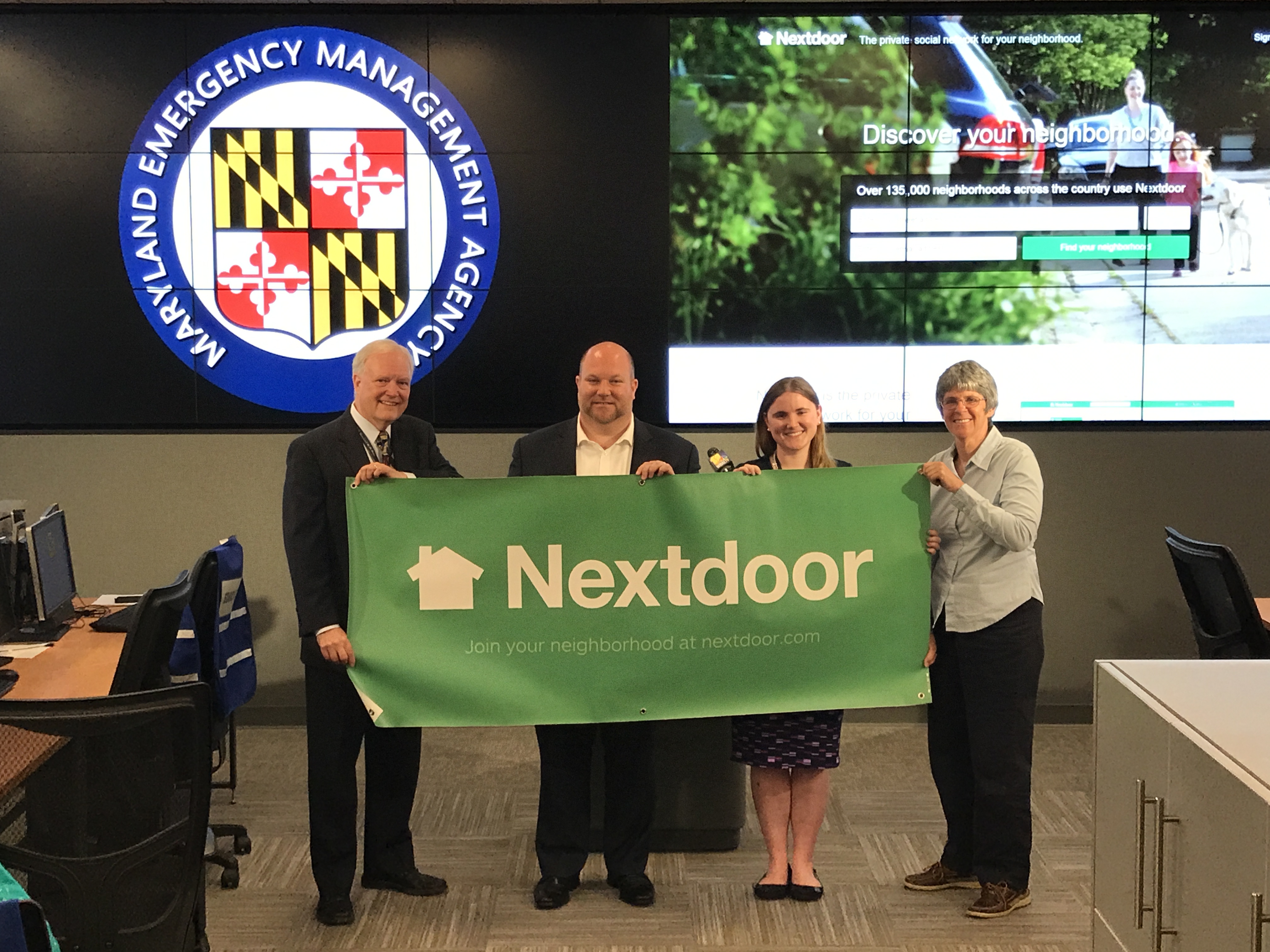
Pictured from left to right: MEMA Executive Director Russ Strickland, Nextdoor Senior City Strategist and Professional Neighbor Joseph Porcelli, MEMA Digital Engagement Coordinator Emily Allen, and Nextdoor Member Claire Corcoran.
REISTERSTOWN, Md. (April 20, 2017) — Earlier today, the Maryland Emergency Management Agency (MEMA) announced a partnership with Nextdoor (nextdoor.com), the private social network for neighborhoods, to improve statewide and neighbor-to-neighbor communications before, during, and after emergencies.
MEMA will use Nextdoor to connect with neighbors by sharing news and updates and providing preparedness and alert information directly to communities. MEMA and Nextdoor neighborhoods will be able to work together to increase resiliency across Maryland.
“MEMA is the first State emergency management agency to join Nextdoor, and we are thrilled to have this additional tool to help us connect with Marylanders,” said MEMA Executive Director Russell Strickland. “Emergency situations require quick action. Nextdoor gives us the ability to target communications by geography, such as regions or flood zones, which will help us share timely information with those who need it.”
To date, Nextdoor has proven to be an essential and well-adopted tool for Maryland residents. More than 2,700 neighborhoods across Maryland are using Nextdoor to stay connected.
Maryland residents can create private neighborhood websites to share information, including neighborhood public safety issues, community events and activities, local services, and even lost pets with Nextdoor. MEMA will be able to post information, such as important news, preparedness information, and emergency notifications to communities across Maryland.
“We have always invested in innovative ways to increase safety for our residents,” Executive Director Strickland continued. “With Nextdoor, we can help empower neighbors to build community, which ultimately creates stronger, safer more resilient places to call home.”
Nextdoor is free for residents. Each Maryland neighborhood has its own private Nextdoor neighborhood website, accessible only to verified residents of that neighborhood. Neighborhoods establish and self-manage their own website and MEMA will not be able to access residents’ websites, contact information, or content. All members must verify that they live within the neighborhood before joining. Information shared on Nextdoor is password protected and cannot be accessed by Google or other search engines.
Residents interested in joining their neighborhood’s Nextdoor website can visit www.nextdoor.com and enter their address.
Maryland preparedness information can be accessed on the Maryland Emergency Management Agency’s website at mema.maryland.gov. You can also view the video of today’s announcement on MEMA’s Facebook Page at www.facebook.com/MDMEMA.
March 19-25 is Severe Storms Awareness Week
March 20th, 2017Spring Season Brings Chances for Hazardous Weather in Maryland
March 19-25 is Severe Storms Awareness Week
Snow may still be on the ground in many parts of Maryland, but now is the time to begin thinking about the upcoming severe storms season. Maryland Severe Storms Awareness Week begins Sunday, March 19, and the Maryland Emergency Management Agency (MEMA) is teaming up with the National Weather Service and local emergency managers to promote citizen awareness and preparedness.
During spring, Maryland is at risk for heavy rainstorms, flooding, damaging winds, tornadoes, hail and lightning. All of these hazards typically occur throughout the state; however, residents can “be weather prepared” by ensuring that they know how to receive warnings and practice safety tips.
“Spring is the time of year when we can experience dangerous thunderstorms, flooding, and even tornadoes,” said Governor Larry Hogan. “Maryland residents should follow the advice of local and state officials and use common sense when severe weather is in the forecast.”
The National Weather Service agrees with that assessment. “Maryland experiences severe storms regularly during the spring,” said NWS Warning Coordination Meteorologist Christopher Strong. “Our area is particularly at risk for damaging winds and flooding. We also see hailstorms and even tornadoes. In fact, Maryland has had nearly 100 tornadoes in the past 10 years.”
The National Weather Service and MEMA work closely together and with local emergency managers and other government agencies to identify and monitor severe weather systems, develop preparedness plans and safety information and coordinate the response to these storms.
“Severe Storms Awareness Week is a chance to think about the hazardous weather that regularly occurs in Maryland,” said Russ Strickland, Executive Director of MEMA. “Plan now for what you or your family should do in case of a severe weather alert or warning — get indoors to a safe space, then, communicate with your neighbors, friends and family to make sure they’re aware of the situation and are safe.”
Now is the time for residents to prepare for severe storms by taking the following actions:
- During flooding, never enter an area where water is flowing over a road and you cannot see the pavement. Turn around, don’t drown!
- If a severe thunderstorm warning is issued or you are experiencing strong winds, get to a sturdy shelter and stay indoors away from windows.
- Tornadoes can form rapidly in the right conditions. If there is a tornado warning or you see a tornado, quickly get inside and go to the lowest floor possible.
- If you hear thunder, you are close enough to be struck from a fringe lightning strike. More than 98% of lightning casualties are from people outdoors—get indoors or inside your vehicle if possible.
Additional information can be found on the “Weather Ready” website at weather.gov/lwx/weatherready and the MEMA website at mema.maryland.gov.
Governor Larry Hogan Signs Executive Order Declaring State of Emergency in Maryland in Anticipation of Snowstorm
March 13th, 2017Click here to read the entire Executive Order declaring a State of Emergency.