
Maryland Fishing Report – November 25
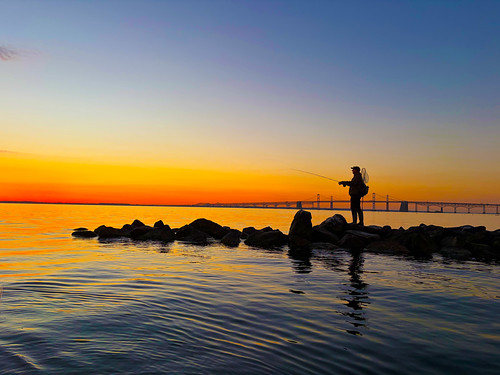
This angler enjoys a beautiful sunrise on the Chesapeake Bay. Photo by Daniel Neuland
This week is a time of reflection for many to be thankful for all that is precious, like family and friends. Anglers may also reflect on a year’s worth of fishing adventures, rewards, and moments to hold dear, like quiet and peaceful times at one’s favorite fishing spot.
Forecast Summary: November 25 – December 1
Main Chesapeake Bay surface and river mouth water temperatures are holding in the mid 50s. Deeper Bay waters are slightly warmer than surface temperatures. Temperatures in smaller rivers and streams are hovering in the mid 40s. Currently there is adequate oxygen in most Chesapeake Bay bottom waters. Due to the continued dry conditions, Bay salinities are running higher than normal throughout Maryland waters.
Expect average flows for most Maryland rivers and streams. Expect average clarity for most Maryland portions of the Bay and rivers. To see the latest water clarity conditions on NOAA satellite maps, check Eyes on the Bay Satellite Maps. There will be above average tidal currents through Sunday following the November 24 full moon.
As always, the best fishing areas could be further refined by intersecting them with underwater points, hard bottom, drop-offs, and large schools of baitfish.
For more detailed and up-to-date fishing conditions in your area of the Bay, check Eyes on the Bay’s Click Before You Cast.
Fishing is currently good for striped bass, but the weekend does not look too promising. Anglers are watching water temperatures steadily drop into the mid-50s and lower and striped bass are moving to deeper and warmer waters. Anglers are drifting cut bait or casting a mix of paddletails and soft plastic jigs in the Conowingo Dam pool for striped bass. Large blue catfish will be in the mix when using cut bait.
There is still some striped bass action in the shallower waters during the morning and evening hours, but much of the action is transitioning to jigging along channel edges. Soft plastic jigs that are often rigged with skirts are working well as are crankbaits, metal jigs, and bucktails dressed with twistertails.
Anglers are reporting finding striped bass along the channel edges at the mouth of the Susquehanna River, the Pooles Island area, the Love Point rocks, the mouth of the Chester River, the mouths of the Gunpowder and Patapsco rivers, and Podickory Point. Most anglers are jigging but a few anglers are drifting live eels with good success.

Rich Watts sent us this picture from his depth finder of a compact school of white perch that he was fishing on. Photo by Rich Watts
Trolling is becoming more popular as striped bass move to deeper waters and air temperatures are brisk at times. Umbrella rigs with bucktails dressed with sassy shads as trailers are popular. Tandem-rigged bucktails and Storm Shads are also in most trolling spreads. All are being pulled behind heavy inline weights; braid helps cut down water resistance.
Anglers looking for white perch are finding them in about 30 feet of water holding close to the bottom on their depth finders. Using bottom rigs baited with pieces of bloodworms or lug worms will entice white perch to bite. Dropper rigs fitted with 2-inch Gulp soft plastics often work wonders without the hassle of bait. If wind and drift are at a minimum, a single small jig can hold bottom well enough to get into the action.
Blue catfish are active this week and can be found in the deeper channel waters. The mouth of the Susquehanna and North East rivers are good places to find them. All the tidal rivers in the upper Bay have populations of blue catfish and they can be found in the lower to mid-range sections of the rivers. Using cut bait and scented bait fished close to the bottom is the most popular way to fish for them. Chesapeake Channa tend to be somewhat dormant during the fall and winter, but fishing large minnows under a bobber in sunny and shallow areas during the afternoon hours can be an option.
Water temperatures in the middle Bay are holding around 56 degrees and a few degrees cooler in the tidal rivers this week. Wind and weather this week could make it difficult to go fishing on the open waters of the bay.

This fishing crew is happy about jigging up a few nice Bay Bridge striped bass recently. Photo by Craig Roberts
The Bay Bridge has been offering good fishing for striped bass this month and the action continues, it will just be a case of Bay conditions. The striped bass are holding tight to the deep bridge piers and the rock piles. Jigging has been the most popular way to fish lately, although some anglers are drifting cut bait, live eels and small white perch to the pier bases.
Reports this week from anglers tell of striped bass being on the move. What was a hotspot three days ago is barren of striped bass on the next trip. One key observation that keeps repeating itself is that the best jigging and casting action to breaking striped bass is occurring early in the morning at dawn, and the last hour or so before dark. The old “early bird gets the worm” adage comes to mind. Trolling tends to offer better success during the daytime hours when trolling deep with umbrella rigs or tandem-rigged bucktails along the major channel edges.
The lower Choptank River tends to be a focal point for many striped bass anglers, but Eastern Bay is another excellent location to explore. Striped bass action is being noted near the Little Choptank and Taylors Island, the mouth of the Severn and off Kent Island and Thomas Point. Thanksgiving’s rough weather promises to stir the Bay up a bit.
White perch have moved deep at some of the tidal river mouths, and into the bay at some locations. A good depth finder is crucial to finding deepwater lumps and structure where they are stacked up. When found, they can offer some excellent fishing opportunities. Dropper rigs with small jigs or shad darts tipped with grass shrimp or pieces of bloodworm or lug worms. Two-hook Sabiki rigs are also a popular dropper rig to use, or two hook bottom rigs. Using 2-inch jigs on a dropper rig will allow faster unhooking and redeployment when you’re on a school of white perch.
Blue catfish are still active this week and can offer anglers a little more shelter from the wind in the middle to upper reaches of the Choptank and Tuckahoe. Fresh cut bait or scented baits are popular offerings. The blue catfish can be found in the channels and anchoring up with a chum pot on the bottom is a good way to draw them close to the boat. Shore-based anglers have numerous access points to cast and peacefully watch a rod sitting in a forked stick.

We know there is a smile under that balaclava, who would not with this nice striped bass. Photo by Travis Long
The story this week is that the striped bass are on the move. Anglers locate a school of baitfish, and it is mayhem for a short while and then they’ve gone somewhere else. They seem to be constantly on the move. The anglers who are casting into breaking fish or jigging have been finding the best opportunities at dawn and after sunset.
The lower Potomac and Patuxent rivers have been a focal point for anglers on the western shore in search of striped bass. Tangier Sound, Hoopers Island, and the mouth of the Nanticoke River offer excellent fishing on the Eastern Shore for those chasing breaking fish or jigging to suspended striped bass.
The striped bass are holding more to the deeper edges of the channels, often at about 25-30 feet. The steeper edges often hold the most promise because currents are swifter there where baitfish get swept along by currents. Striped bass can easily move about in the current and pick off struggling baitfish. juvenile menhaden make up the bulk of the baitfish coming down the rivers, but bay anchovies can still be around, and juvenile American shad and river herring can be part of the mix.
Soft plastic jigs and metal jigs work equally well, but if anglers are using metal jigs, they are urged to replace treble hooks with single inline hooks. It makes unhooking fish to be released easier, and they are a lot gentler on the fish. Catch-and-release fishing is generally safe for the fish this time of the year due to cold and salty water. It is a wonderful time of the year for striped bass anglers, and it is good to see the fish full of color and heavy shoulders.
Blue catfish are holding in the channels of the major tidal rivers this week and waiting for an angler’s cut or scented bait. There are blue catfish populations in every tidal river within the lower Bay, but the tidal Potomac, Patuxent, and Nanticoke rivers are standouts.
Freshwater Fishing
The 2026 trout season for put-and-take management waters is about over, and only the most die-hard anglers will be working the waters for holdover trout that dodged the buffet of Powerbait this year. Anglers will be fishing the more secluded waters away from the stocking sites with a mix of spinners, gold spoons, and an assortment of flies such as muddler minnow patterns or nymphs. The delayed harvest and catch-and-return trout management waters will provide plenty of fun fishing action all winter long. Hopefully we’ll get some much-needed rain this winter or even snow melt to bolster water flows. The central region reservoirs had a difficult time trying to maintain capacity levels in the reservoirs, which affected water releases into the tailrace trout waters.
DNR released the results of the 2026 Volunteer Trout Angler Survey, and they show some interesting survey data. Read a full survey report on the DNR website.
Water temperatures in the nontidal and tidal waters are still comfortable for largemouth bass, and they are feeling the urge to fatten up for the winter. They’ll be looking for baitfish and crayfish out in the open between the shallower areas and the deeper waters. The grass beds have declined to the extent that they don’t provide enough cover, and crayfish and baitfish will be looking for cover and warmer water temperatures in the deeper areas.
Spinnerbaits, small crankbaits, paddletails, and jerkbaits are all good lure choices when working the open water areas. Largemouth bass often like to hold near structure waiting for prey to pass by, sort of like the traffic cop waiting behind a billboard sign for a speeding car. Working whacky rigged soft plastics or craw jigs near the structure is a great way to entice a lurking largemouth bass.
Biologists stocked 2,000 largemouth bass into the Choptank River and Tuckahoe Creek during the month of October. A couple hundred bass remain inside at the Manning Hatchery to be stocked out before the end of the year. It is hoped these largemouth bass will help bolster local populations.
Crayfish are the first choice for smallmouth bass, and they will make a great effort to find them. It is not uncommon to see the tips of the jaws of smallmouth bass this time of the year showing damaged skin from pinning crayfish to the bottom to snap them up. Any lure that mimics a crayfish will be a sure winner. Of course, baitfish are on the menu, so tubes and swimbaits are good lures to use also. The upper Potomac, the Monocacy, Liberty, Prettyboy reservoirs, and Deep Creek Lake are all good places to fish for smallmouth bass. Although a bit of a well-kept secret, the lower Susquehanna contains some trophy-sized smallmouth bass.

Vinny Spilker caught this large chain pickerel on his birthday recently. Photo by Rich Hershel
The colder fall and winter months herald in the much-anticipated chain pickerel fishery in nontidal and tidal waters throughout the state. This is an exciting and fun fishery for anglers of every caliber. There is nothing subtle about chain pickerel, they are an ambush predator and attack an angler’s lure with total abandon. Now that the grass beds have declined, look for them holding close to sunken structure. There are few things more exciting than seeing a V shaped wake on the surface streaking towards a surface lure like a torpedo.
Chain pickerel are difficult to prepare for eating due to floating bones, much like northern pike, so for most anglers it is a catch-and-release fishery. Spinners, spoons, paddletails, jerkbaits, all work well and it is hard to think of a lure that a chain pickerel will not strike. If chain pickerel are your target, replacing treble hooks with single inline hooks will go a long way to reduce injury to the fish and make removing hooks easier.
Fishing for tautog is good this week at the Ocean City Inlet and the Route 50 bridge area. Most of the tautog being caught are measuring a little short of the required 16 inches but there are some legal-sized fish in the mix. Sand fleas and pieces of crab are the most popular baits.
Striped bass are entertaining anglers casting soft plastic jigs and paddletails around the inlet jetties, docks and piers in the general area. Most of the striped bass fail to meet the 28-inch minimum but there are some being caught within the 28-31 inch slot. The piers of the Verrazano and Route 90 bridges are also excellent places to cast for striped bass.
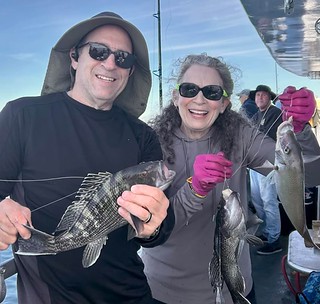
These two happy anglers show off a mix bag of black sea bass and a porgy. Photo by Monty Hawkins
Anglers headed out to the wreck and reef sites are catching a mix of black sea bass, porgies, and flounder. Limit catches of black sea bass are sparse, but most anglers are catching a good amount. Some charter boats are targeting tautog and doing well.
Bluefin tuna are being caught offshore, and anglers report that the bluefins tend to be finicky about taking lures. Currently bluefin tuna measuring larger than 73 inches must be released. Anglers are still heading out to the canyons and fishing for swordfish in the depths. This deep-water daytime fishery has really evolved due to technology advances – 50 to 60 years ago we did not have strobe lights, advanced power assisted reels, braided line and the depth finder technology available today. Back then, swordfish were usually caught at night at depths of around 200 feet. The past two months have seen some amazing swordfish catches in depths of the offshore canyons.
“November is a man past fifty who reckons he’ll live to be seventy or so, which is old enough for anybody- which means he’ll make it through November and December, with a better than average chance of seeing New Year’s.” – Robert Ruark, The Old Man And The Boy.
Maryland Fishing Report is written and compiled by Keith Lockwood, fisheries biologist with the Maryland Department of Natural Resources.
The Forecast Summary is written by Tidewater Ecosystem Assessment Director Tom Parham.
A reminder to all Maryland anglers, please participate in DNR’s Volunteer Angler Surveys.