
Maryland Fishing Report – November 18

Cayla Beam holds a pretty chain pickerel she caught and released recently while fishing on the Tuckahoe. Photo by Justin Wilson
The recent colder weather seems like a knock on the door announcing the winter months will be here soon. The leaves on many trees have fallen but some fish species are still hanging around. Fishing is taking a turn towards more cold water species and few are more popular than the chain pickerel.
Forecast Summary: November 18 – November 24
Main Chesapeake Bay surface and river mouth water temperatures are holding in the upper 50s. Temperatures in smaller rivers and streams are hovering in the mid 40s. Currently there is adequate oxygen in most Chesapeake Bay bottom waters. Due to the continued dry conditions, Bay salinities are running higher than normal throughout Maryland waters.
Expect average flows for most Maryland rivers and streams. Expect average clarity for most Maryland portions of the Bay and rivers. To see the latest water clarity conditions on NOAA satellite maps, check Eyes on the Bay Satellite Maps. There will be above average tidal currents Saturday through Tuesday because of the full moon on November 24.
As always, the best fishing areas could be further refined by intersecting them with underwater points, hard bottom, drop-offs, and large schools of baitfish.
For more detailed and up-to-date fishing conditions in your area of the Bay, check Eyes on the Bay’s Click Before You Cast.

Cooper Goff holds up a large blue catfish he caught in the Conowingo Dam pool. Photo by Don Goff
The colder temperatures of the past week are driving down water temperatures. Most tidal rivers are now showing surface temperatures in the low 50s and Bay waters in the upper 50s. Warmer water resides in depths of 20 feet or more, often as much as 5 to 8 degrees. Baitfish in the form of juvenile menhaden and bay anchovies are moving out of the tidal rivers and once they reach the bay are often swept along steep channel edges by strong currents.
Striped bass activity along these channel edges can be revealed by diving seagulls as striped bass push schools of bait towards the surface. Slicks and resting gulls are worth investigating, and depth finders can reveal fish holding deep suspended off the bottom. Jigging with soft plastic or metal jigs is the most popular way to fish for striped bass this week.
Trolling umbrella rigs or tandem-rigged bucktails dressed with sassy shads behind heavy inline weights along the steeper channel edges at depths of approximately 20-30 feet is a popular way to fish in fall. Chartreuse tends to be the most effective color for sassy shads this time of year.
There is still shallow-water action for striped bass being reported by anglers this week. Casting a mix of soft plastic jigs, paddletails, crankbaits, and jerkbaits near shoreline structure continues to be effective. Inside Baltimore Harbor, the edges of the Susquehanna Flats, the Love Point rocks, and shoreline rip rap all offer structure that attracts striped bass.
Blue catfish are in play this week and can be found from the Conowingo Dam pool south to all the region’s tidal rivers. Various fresh cut baits or scented baits will work well to attract their attention. This is an excellent time of the year to catch blue catfish and pack fillets in your freezer for the winter.
White perch are being found in the lower sections of the region’s tidal rivers and holding in deep waters over oyster beds and other types of structure. If the water depths are not too deep, small Gulp jigs and spin-jigs can be worked close to the bottom. Dropper rigs or two hook Sabiki rigs work well in deeper waters as do bottom rigs baited with grass shrimp or pieces of bloodworm.

Rich Watts caught this large white perch while jigging deep at the Bay Bridge recently. Photo by Rich Watts
Striped bass fishing in the middle Bay is about as good as anyone could ever expect. Water temperatures are in the low 50s in the region’s tidal rivers and baitfish are pouring out of the tidal rivers. The most common baitfish being encountered are juvenile menhaden. In the Choptank River juvenile river herring, silversides, American shad, and bay anchovies can also be in the mix. The mouth of the Choptank River is one of the premier locations where striped bass are lined up waiting for schools of baitfish to be swept along by strong currents from Black Walnut Point to Cooks Point.
The Bay Bridge piers, concrete abutments, and rock piles are holding striped bass this week. Drifting live baits and cut bait back to the pier bases continues to provide action. Casting soft plastic jigs at the bridge pier bases is also effective. The Kent Narrows should not be overlooked for striped bass or white perch.
There has been plenty of striped bass action in Eastern Bay where surface action has been noted when the striped bass push bait to the surface. There continues to be shallow-water action in the morning and evening hours throughout the middle Bay but is declining due to colder water temperatures. Casting paddletails, poppers, and jerkbaits are popular lures to use.
Anglers are reporting catching and releasing significant numbers of striped bass when jigging. All are urged to flatten the barb on soft plastic jigs and replace any treble hooks on metal jigs with inline single hooks with flattened barbs. It makes the release process a lot easier and reduces injury to the fish.
Trolling is a popular option for many anglers during the fall months when water temperatures dip and striped begin holding deep along channel edges. It takes heavy conventional rods and reels to pull umbrella rigs and tandem rigged bucktails behind heavy inline weights, which are needed to get rigs down to depths of 20-30 feet and deeper.
White perch have moved out to the deeper waters in the lower sections of the region’s tidal rivers where water temperatures can be over 5 degrees or more over surface temperatures. The schools of white perch can commonly be detected on depth finders holding over oyster bars. Fishing with two-hook Sabiki rigs or bottom rigs tipped with grass shrimp or pieces of bloodworm work well. Dropper rigs with 2-inch Gulp soft plastics or single spin-jigs can also work well.
Fishing for blue catfish in the upper Choptank River from approximately the Dover Bridge area upriver to Denton or the Tuckahoe beyond the Route 328 bridge offers some good fishing action. Cut bait or scented baits work well and a small torpedo float rigged a few inches from the hook helps keep baits slightly off the bottom.

This happy angler holds up a nice striped bass caught in the lower Patuxent River by jigging. Photo by Travis Long
The fall striped bass fishery in the lower Bay is going great guns this week. The recent cold weather has caused the tidal river water temperatures to drop, and baitfish are pouring out of the tidal rivers and being swept along steep channel edges by strong currents. The striped bass have no trouble navigating in these currents and are taking advantage of the buffet of baitfish headed their way.
Jigging and trolling are the most popular ways to fish the channel waters this week. Jigging is perhaps the most fun, due to the light tackle involved and the fighting of the fish. Both soft plastic and metal jigs are very effective when jigging over fish suspended along channel edges. A good depth finder helps make the task of locating them easier and sometimes diving seagulls can be encountered when striped bass push the bait schools to the surface. That is always an exciting time for anglers. Anglers who are trolling will be working the steep channel edges with umbrella rigs and tandem-rigged bucktails pulled behind heavy inline weights to get down to the depths where fish are holding.
The lower Patuxent River and the lower Potomac River south of the Route 301 Bridge has been offering exceptional striped bass fishing for anglers who are jigging and trolling. Shore-based anglers fishing from various shoreline access points are also getting in on the action during the morning and evening hours. The Hooper Island cuts; the mouth of the Nanticoke River, and the Tangier Sound area are also offering good fishing for striped bass.
White perch are being found this week in the deeper waters of the tidal rivers, often near oyster reefs or bridge piers. The lower Potomac River’s feeder creeks and rivers are a good place to look. The lower Patuxent River near the Route 4 bridge, the lower Nanticoke River, and Tangier Sound are excellent locations to look for white perch holding over oyster reefs. Two-hook Sabiki rigs or bottom rigs baited with grass shrimp or pieces of bloodworm work well as do dropper rigs with small 2-inch soft plastics when fishing deeper waters. In some areas fishing with small spin-jigs and soft plastic jigs can work well if one can keep lures close to the bottom.
Blue catfish are in play this week, and this time of the year, and offer a great time to load up on a bunch of them and pack them away in your freezer. The lower Potomac River and the Patuxent River from Jug Bay south past Benedict offer excellent blue catfish opportunities. The Nanticoke River near Sharptown and the lower Marshyhope are two of the best locations on the Eastern Shore to catch blue catfish. Fresh cut bait or scented baits are the ticket to the action. Lowering a chum pot with ground menhaden can do wonders for attracting the blue catfish close to your boat. Shore based anglers can get in on the action as well from shore access points.
Freshwater Fishing
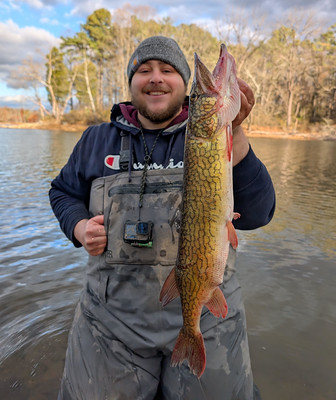
Roy Conklin caught this hefty chain pickerel recently at Loch Raven Reservoir. Photo courtesy of Roy Conklin
The recent cold weather is driving water temperatures down and many freshwater fisheries are beginning to shift to a late fall/early winter phase. Largemouth bass and crappie will start to hold in deeper waters near structure. Coldwater fish such as smallmouth bass, walleye, trout, and chain pickerel do well in cooler waters.
Fishing for smallmouth bass and walleye is good this week in Deep Creek Lake and the upper Potomac. Smallmouth bass can also be found in Liberty and Prettyboy reservoirs. The smallmouth bass are feeding on baitfish and crayfish attempting to move from shallower waters where grass beds have declined to deeper structure where they can find refuge for the winter. Spinnerbaits, crankbaits, paddletails, and craw jigs are all good baits to use. Walleye can be found along steep rocky shores of Deep Creek Lake during the evening hours and working jerkbaits along the deeper edges is a good way to target them. Current breaks and deep holes are good places to fish for walleye in the upper Potomac River.
Largemouth bass are holding in deeper waters as November progresses, and they will be ready to grab any baitfish or crayfish attempting to move to deeper waters. Spinnerbaits, paddletails, small crankbaits, and jerkbaits are all good lures to use. They will often hold near structure and wait for prey to come their way. If targeting structure, wacky rigged stick worms or similar soft plastics can entice a largemouth bass to pick up a bait.
The cooler water temperatures offer good opportunities to fish for landlocked striped bass. Populations of them are found in Liberty and Triadelphia reservoirs in the central region. Slow trolling with diving Rapala type lures is a popular way to fish for them.
The fall and winter months herald in fishing for chain pickerel in the tidal and nontidal waters throughout Maryland. They are an exciting fish to catch and most anglers who fish for them release them to fight another day. The largest chain pickerel can be found in deeper waters near the remnants of grass beds or structure in the form of sunken wood, bridge piers or anything that provides a place to hold and be ready to ambush a passing baitfish. The smaller chain pickerel can be found near sunken wood along shorelines.
Most lures will work for chain pickerel, they’re not too picky. Spinners, spoons, paddletails, and jerkbaits all work well. If you are targeting chain pickerel, it is a good idea to replace treble hooks with inline single hooks. It will be much easier to unhook a fish and a lot easier on the fish. Chain pickerel are known for attacking lures with abandon and tend to engulf them.

Christopher DePatto stands next to a big swordfish he caught in October. Photo courtesy of Christopher DePatto
Fishing for tautog in the Ocean City Inlet and Route 50 bridge area continues to be very good this week. Anglers are catching some hefty tautog on pieces of green crab and sand fleas. A few flounder are also being caught, representing the last of the flounder to head offshore.
Fishing for striped bass in and around the inlet as well as the Route 90 and Verrazano bridges has been providing a lot of fun fishing for anglers. Casting soft plastic jigs and paddletails are popular lures. Most of the striped bass being caught are measuring short of the 28-inch minimum and some over the 31-inch slot size but are providing a lot of fun catch and release action.
Fishing for black sea bass is good this week and anglers are bringing nice catches back to the Ocean City docks. Anglers who are targeting tautog on the inshore wreck and reef sites are also enjoying good fishing.
Offshore the fishing talk is all about swordfish. It is comforting to see a rebound in this fishery. There have been at least four swordfish caught recently in the 500-pound size range. Broadbill swordfish are an exciting and tough fish to bring to gaff. They are the most difficult to bring up from the depths, it seems like they never give up. Any angler who has tangled with a large one will attest that is most likely the hardest fighting fish they’ve ever caught.
“Man is troubled by what might be called the Dog Wish, a strange and involved compulsion to be as happy and carefree as a dog- – James Thurber
Maryland Fishing Report is written and compiled by Keith Lockwood, fisheries biologist with the Maryland Department of Natural Resources.
The Forecast Summary is written by Tidewater Ecosystem Assessment Director Tom Parham.
A reminder to all Maryland anglers, please participate in DNR’s Volunteer Angler Surveys.