
Maryland Fishing Report – September 23

Joshua Campbell was fishing recently on an Ocean City party boat when he caught this huge summer flounder. Photo courtesy of Joshua Campbell
Maryland is feeling the effects of an offshore Nor’easter. Coastal areas will see some beach erosion, coastal flooding and river water levels will be elevated. This is our introduction to fall, but calmer and pleasant weather is in the forecast, offering a wonderful time to enjoy the outdoors.
Forecast Summary: September 23 – September 29
Main Bay surface and river mouth water temperatures have dropped to the mid 70s. Temperatures in smaller rivers and streams have dropped to the mid 60s and will likely continue falling all week. Currently there is adequate oxygen in most Bay bottom waters. Due to the continued dry conditions, Bay salinities are running higher than normal throughout Maryland waters.
Expect average flows for most Maryland rivers and streams. Expect average clarity for most Maryland portions of the Bay and rivers. However, expect poor water clarity in the Bush, North East, Sassafras, and Elk River due to algal blooms. To see the latest water clarity conditions on NOAA satellite maps, check Eyes on the Bay Satellite Maps. There will be above average tidal currents all week because of the full moon on September 26.
As always, the best fishing areas could be further refined by intersecting them with underwater points, hard bottom, drop-offs, and large schools of baitfish.
For more detailed and up-to-date fishing conditions in your area of the Bay, be sure to check out Eyes on the Bay’s Click Before You Cast.
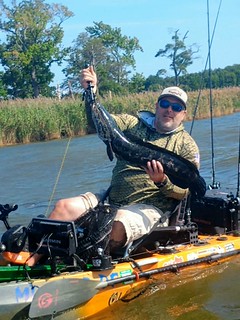
Larry Allman caught this Chesapeake Channa in the Middle River recently. Photo courtesy of Larry Allman
The Conowingo Dam pool will always be a dead end for fish traveling up the Susquehanna River and a buffet of fresh chopped up gizzard shad passing through the power generation turbines. There is good access for anglers at Fisherman’s Park for those casting medium weight surf rods to reach the turbine wash when fishing for striped bass. Drifting cut bait in the dam pool is an excellent way to catch the blue catfish and flathead catfish there, along with some striped bass.
Water temperatures are dropping in the upper Bay and anglers are beginning to enjoy shallow water fishing along the east and west edges of the Susquehanna Flats, as well as promising looking shorelines throughout the upper Bay. Casting poppers and other topwater lures and white or pearl paddletails are the most popular way to fish these areas.
Live-lining small eels near Pooles Island and favorite channel edges is always a favorite fall tactic. There are still spot available in the lower Chester and Magothy rivers and Podickory Point, but the weather system we are experiencing this week may start to push them farther south. The Love Point rocks is a good place to live-line spot or eels this week or to work soft plastic jigs along the bottom during current flows. Watching depth finders carefully when exploring channel edges can lead to finding striped bass suspended off the bottom.
Chesapeake Channa are active this week and fishing for them can offer fun and safe fishing in the more protected upper sections of the region’s tidal rivers and creeks. Casting a variety of soft frogs and chatterbaits over grass beds is an excellent way to target them this week. Casting white or pearl colored paddletails in more open waters near the grass bed edges is another excellent way to fish for them.
A mix of blue catfish and channel catfish can be found in all the region’s tidal rivers this week. Cooling water temperatures are causing them to be more active and to venture out of the deeper channels and move nearby shoal areas.
Locating white perch can be a challenge, but once located they are receptive to spin-jigs and small spinnerbaits cast near shoreline structure during the early morning and evening hours. Dropper rigs and bottom rigs tipped with grass shrimp, peeler crab or small minnows work well in deeper waters.

Mark Hanson found this nice white perch in Eastern Bay. Photo by Mark Hanson
This weather we’re experiencing is putting a damper on fishing this week and when it is all over, anglers may find that bluefish have left the region. Bay water temperatures continue to fall and are now below 75 degrees. Spot, croaker and speckled trout will most likely hang on for another week or so, but they will eventually head south also.
Fishing for striped bass has been good lately, with most of the action occurring in the shallower portions of the bay during the morning and evening hours. This is a great time to fish the morning hours before Daylight Savings ends Nov. 1. Casting poppers is one of the most popular ways to fish the shallower waters; paddletails in pearl or white are also an excellent choice. Anglers are also enjoying catching small speckled trout, hopefully they’ll return next year at a larger size.
Spot are still available and anglers are taking advantage of them still being present and live lining along various channel edges. The Bay Bridge piers and rock piles are a good location for drifting live spot to the pier bases and submerged rocks, and channel edges are also holding striped bass. The channel edge locations vary but some of the traditional locations with good reputations are Thomas Point, Buoy 83 to the False Channel and Hackett’s Point. The 30-foot depth mark tends to be the sweet spot for finding striped bass suspended off the bottom.
White perch can be tough to locate, but once found anglers can enjoy some action. Deep water docks and piers, the older the better, offer structure and food sources for white perch so they are a good place to target with live grass shrimp, peeler crab, or small minnows. During the morning and evening, casting small spin-jigs and spinnerbaits along promising shorelines with structure is a good way to target larger white perch.

Eric Packard caught these two speckled trout recently near Point Lookout. Photo by Eric Packard
The chilly stormy weather will make it tough to fish, but conditions are bound to improve by the weekend. Bluefish are still being found in the lower Bay, but this weather may start to push them south. At present the largest bluefish are being found in the main portion of the Bay, and the deeper waters along the eastern side of the shipping channel tend to offer some of the better fishing. Smaller bluefish are being found in the shallower waters of the Bay, the tidal rivers, and Tangier Sound. The larger bluefish are being caught mostly by trolling surge tube lures behind planers, the smaller ones by casting a variety of lures or trolling small spoons.
Anglers are enjoying good fishing in the shallower waters of the Bay and lower sections of the tidal rivers. The weather will make it tough to be on the water for today, but conditions should improve by the weekend. Casting paddletails and a mix of other lures along shorelines has proven to be a good way to catch a mix of striped bass, small bluefish and speckled trout, also known as spotted trout.
Live-lining spot continues to be a popular method to fish for striped bass this week. If conditions calm down, the 30-foot depths of several popular channel edges will be good places to start the search for striped bass: the steep channel edge from St. Georges Island to Piney Point, the channel edge off St. Clements, and the channel edges in the lower Patuxent, Cedar Point, and Cove Point.
Fishing for spot and croaker continues to be good in most areas of the lower Bay and excellent in the lower Patuxent River. Anglers are also seeing a mix of kingfish and small speckled trout. Bloodworms are a very precious and expensive commodity so many anglers are using artificial bloodworm baits or lug worms, or mixing pieces of nightcrawler worms in bloodworm juice when they cut up their bloodworms.
The large red drum continue to entertain anglers with some exciting catch-and-release action this week. They are being found schooled up at times feeding on small menhaden, either on the surface or deep below. Diving gulls often mark the surface action; slicks are a telltale sign of action below. Casting large soft plastic jigs is the most popular way to fish for them.
White perch are proving difficult to find at times and there is no doubt that populations are generally down throughout Maryland’s portion of the Chesapeake. If anglers explore the type of habitat white perch prefer, they can improve their odds of finding them. Structure, current flow, and a food source are three things that are very important to white perch. If one can put those three elements together in an area, one stands a better chance of finding white perch. Grass shrimp is one of the best baits you can use if you plan to use bait. You can catch your own and avoid the high price of bloodworms. Check the DNR website for some pointers on catching your own grass shrimp. The other option is casting small spin-jigs, Beetle-spin type lures, and small spinnerbaits near shorelines during the morning and evening hours.
Blue catfish are becoming more active as water temperatures cool. The fall months are a great time to find them venturing out of the deeper channels to nearby shoal areas. The tidal Potomac, Patuxent, Nanticoke, and Wicomico rivers are excellent places to fish for blue catfish. A simple one hook bottom rig of a sliding sinker and circle hook or a traditional J-style hook is all that is needed. A variety of cut fish baits, scented chicken or other scented baits work well.

Matt Polm holds up a nice crappie he caught recently in a tidal river. Photo by Matt Polm
The rivers and creeks of the western and central regions are receiving a bump in water levels and flows this week due to the rain we are receiving. This is a good thing for the smaller creeks that are scheduled to be stocked with trout in October for the fall put-and-take trout stockings. It is not uncommon for crews to relocate trout destined for a particular stream or creek because of low water conditions. If stream flows revert to low water conditions, trout anglers should be prepared for such adjustments. Those adjustments will be posted on the trout stocking website on the day of the stockings.
Anglers are enjoying fishing the many rivers, lakes, ponds, and reservoirs in the state for a wide variety of species. Largemouth bass and smallmouth bass are still holding to a summer pattern and now that area waters are beginning to cool, the fish are becoming more active. Bass are not the only fish that are becoming more active in area reservoirs. Crappie, chain pickerel, trout, tiger muskies, and in some select reservoirs, landlocked striped bass can be found.
The upper sections of the Bay’s tidal rivers provide a lot of excellent fishing for largemouth bass, Chesapeake Channa, chain pickerel, and crappie. These sheltered waters can provide safe and comfortable fishing for small boats, canoes and kayaks.
The surf, coastal bays, and offshore waters are feeling the effects of rain and wind from the Nor’easter off the coast. It will take some time for conditions to calm down in the ocean and for water clarity to improve in the back bay areas. Hopefully those conditions will improve by the weekend.
Last weekend surf anglers were catching kingfish, spot and small pompano. Dogfish, cownose rays, and sandbar sharks were pestering those fishing with larger cut baits. This current blow may be just what is needed to start the annual southward migration of large red drum along Maryland’s beaches.
When conditions improve in the inlet and Route 50 bridge area, anglers should still be able to find large sheepshead by fishing live sand fleas close to the rocks, bulkheads, and bridge piers. Hopefully water clarity will improve quickly, and anglers can target flounder, croaker and speckled trout in the inlet and channels leading towards the inlet. The East Channel has been a popular location to drift for flounder and croaker.
Outside the Ocean City Inlet, fishing for large flounder on the shoals and wreck and reef sites should continue. The only limiting factor will be rough seas. The same goes for boats headed out to the canyons. Catch-and-release fishing for white marlin should continue and deep drop fishing for blueline tilefish offers the opportunity to bring fish back to the docks.
“In the autumn, fishing is coming to an end and each day you are parting with it- for a long time, for a whole six months.” – Sergei Aksakov (1791-1859)
Maryland Fishing Report is written and compiled by Keith Lockwood, fisheries biologist with the Maryland Department of Natural Resources.
The Forecast Summary is written by Tidewater Ecosystem Assessment Director Tom Parham.
A reminder to all Maryland anglers, please participate in DNR’s Volunteer Angler Surveys. This allows citizen scientists to contribute valuable data to the monitoring and management of se