Natural Heritage Program Spotlight: The SWAP!

Cover of the 2025-2035 Maryland State Wildlife Action Plan, which has been completed for review by the federal government.
The tagline of the 1990s television show Captain Planet told kids weekly, “the power is yours!” Just like the adventures those cartoon characters faced every week, Maryland’s State Wildlife Action Plan (SWAP) is a real-life Planeteer challenge: How should we as Maryland citizens work collaboratively to protect rare species and keep abundant wildlife from becoming rare in the future? Natural Heritage Program staff and community stakeholders across the state have been working tirelessly to tackle this challenge. We are proud to share that a final draft is complete!
Every ten years, all fifty states and the District of Columbia are required to update their SWAP. The plan is meant to serve as a non-regulatory guiding document for conservation efforts concerning the state’s Species of Greatest Conservation Need – including all shapes and sizes of wild animals and plants – and the habitats where we find them. The last SWAP cycle was completed in 2015. The updated SWAP was due and submitted to the federal government on May 1, 2026. Compliance is necessary for states to access State Wildlife Grant (SWG) funding, which funds a large chunk of non-game species conservation work nationwide. According to the US Fish and Wildlife Service, these funds are used “for improving public and private lands, ensuring the availability of sufficient habitat for species, and providing quality recreational experiences for outdoor enthusiasts of all kinds.” Examples of funded efforts include research, fish and wildlife surveys, species restoration, habitat management, and monitoring. States must also match 25-35% of those funds, and for Maryland that funding often comes from the Chesapeake Bay and Endangered Species Fund. Anyone can donate to it on their tax return each year.
“Let our powers combine!” ~Captain Planet
Writing a plan to protect a bright future for all wild things in Maryland is not an easy task – and not to be undertaken alone. Expertise and experience is spread around like cottonwood seeds in a state like Maryland, so the invitations to discussion were designed to be as inclusive and comprehensive as possible. To capture the big picture of the work being done, a lot of people needed to get together in the same rooms and talk to each other, from government agencies to nonprofit organizations, business owners to community groups. More than 30 meetings were held in 2024 and 2025 to prepare for the 2026 SWAP submission, with more than 250 people involved in its development from more than 100 organizations. Once all those insights and contributions were gathered, they all had to be boiled down into one hefty document (almost 500 pages with 13 appendices), edited meticulously, and then opened up for public comment.
As it reads in the SWAP Acknowledgement section: “Ultimately, it is the citizens of Maryland who will reap the benefits of the direction of Maryland’s State Wildlife Action Plan. It is to them that these efforts are dedicated. [We thank] the citizens of Maryland for their input during the revision process and for the public appreciation of Maryland’s wildlife that drives statewide conservation efforts.”
For the 10 years until the next update, everyone who works in wildlife conservation in Maryland will have collaborative data in a statewide plan to point to as they prioritize projects, justify next moves, and plan for the future. Even hobby naturalists can check up on their new favorite rare species and see what we have planned to do to help. And the priority any conservation activity conducted by the department can be confirmed against the SWAP.
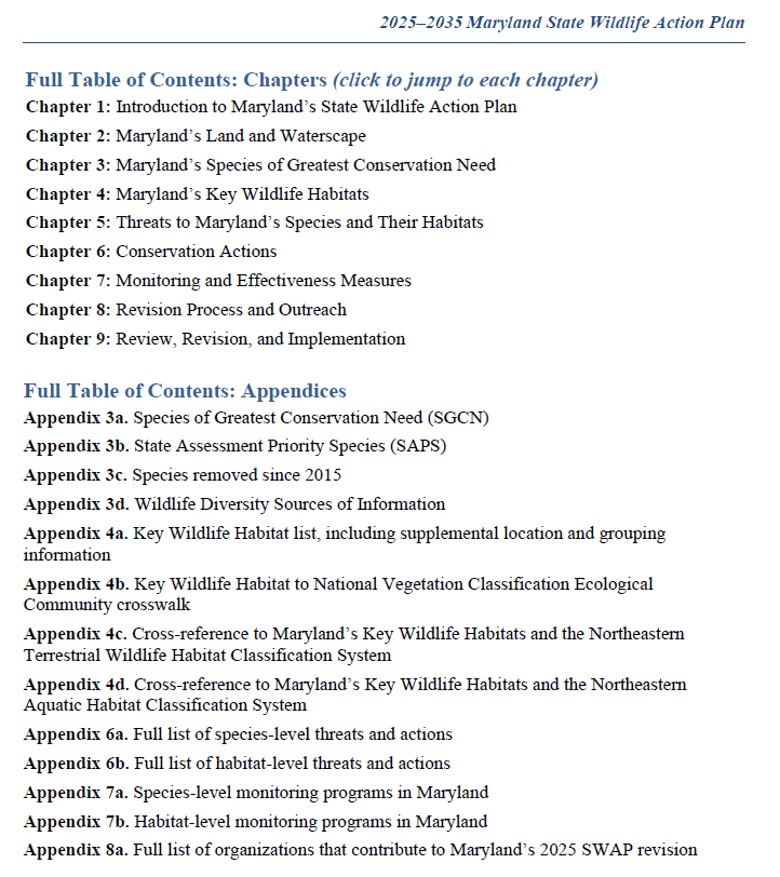
The final version will be available on the Maryland DNR website upon approval from US Fish and Wildlife Service. Below is a snapshot of the draft report’s table of contents: