
Whole Watershed Program Projects Prepare for Coordinated Restoration Work
State management team identifies 37 priority projects and dedicates funding for next year
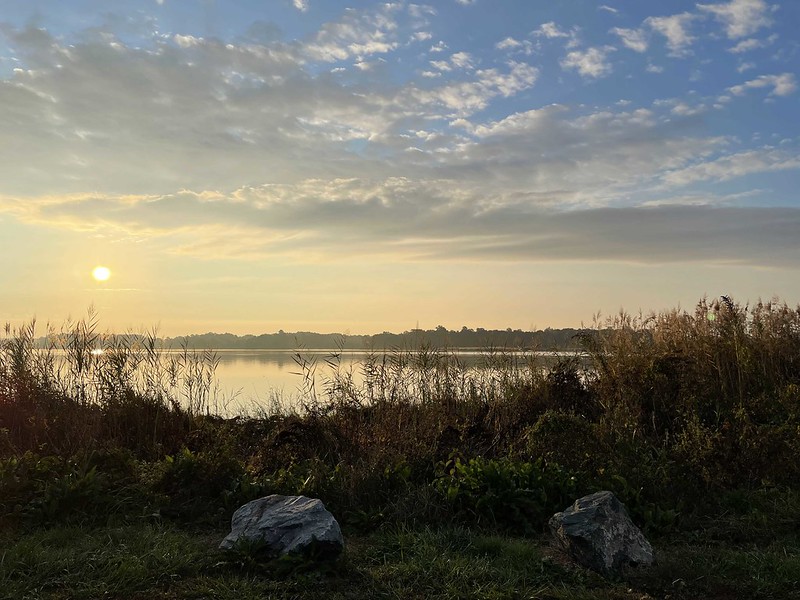
Sunrise over the Choptank River. Several projects will launch on the Upper Choptank as part of the Whole Watershed Program. Photo by Lyn Banghart, submitted to the 2022 Maryland Department of Natural Resources Photo Contest.
Planning and development for Maryland’s Whole Watershed Program is underway, with stormwater management, stream and marsh restoration, tree plantings, invasive species management, and many other projects advancing to help shape the state’s collective effort on targeted watershed restoration.
In March of 2025, the state selected five watersheds that would receive initial funding through the Whole Watershed Act, which passed in 2024. Program teams from these watersheds—Antietam Creek in Washington County, Baltimore Harbor, Newport Bay near Ocean City, the Severn River in Anne Arundel County, and the Upper Choptank River on the Eastern Shore—proposed detailed plans for restoring waterways, uplifting communities, and enhancing habitat areas.
“The projects selected for the Whole Watershed Program represent bold visions for the future of watershed restoration in the state,” Maryland Department of Natural Resources Deputy Secretary David Goshorn said. “These are projects that are geared toward addressing specific, local issues—reducing flooding in neighborhoods, building equitable waterfront access, and restoring habitat areas. Making real progress on these goals will benefit these communities, the Chesapeake Bay and its surrounding watershed.”
The program sponsors that lead the effort in each watershed will receive five years of technical and financial assistance for the design and implementation of the conservation and restoration work. In 2025, the overseeing state management team, consisting of experts from across Maryland agencies, helped the selected watershed sponsors to identify priority projects that will be the focus of the upcoming year of restoration work. The management team includes experts from the Maryland departments of Agriculture, Emergency Management, Environment, Natural Resources, and Planning, along with the Critical Area Commission.
The state management team identified 37 projects, bringing in more than 75 partners to work across the five watersheds. For the next fiscal year, the state is funding a total of $11,248,876 for the projects. The program sponsors, which coordinate the efforts for each individual watershed, also secured matching funding of $11,007,788 from other funding sources outside of the Whole Watershed Program.
Aligning with new Chesapeake Bay restoration goals that focus on improving shallow waterways such as creeks, streams, and rivers, the Whole Watershed Program directs efforts to areas where targeted action can have significant effects on improving water quality, restoring habitat, and providing spaces for recreation.
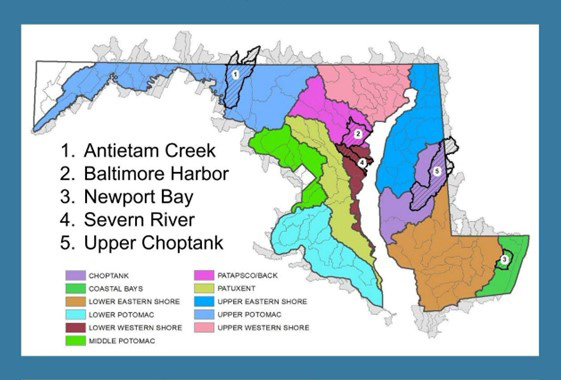
The watersheds selected for the Whole Watershed Program.
“The wide range of projects put forward for the Whole Watershed Program demonstrates how valuable this program is,” DNR’s Watershed and Climate Services Director Natalie Snider said. “These are projects that are tailored to the unique needs of each watershed, and they will serve as examples of how targeted restoration can improve water quality, protect communities, and improve habitat.”
Prioritized projects include restorations to Horner Marsh and Bay Creek marsh in the headwaters of Newport Bay, which will build elevation to provide vital habitat for several species in parcels that have been impacted by sea level rise and extensive ditching.
In the Severn River, the program will support the Watershed Steward’s Tree Ambassador Program, which will focus on planting trees in low-income urban areas. Other projects there include oyster reef construction, stormwater management, increasing equitable public access at the Mulberry Hills trail, and conservation of the Jabez Branch of the Severn River.
In the Baltimore Harbor, projects will aim toward the creation of equitable waterfront access in the Cherry Hill neighborhood, establishing a tidal wetland near the Medstar Harbor Hospital, and launching a Reel Rewards project to provide anglers with a bounty for fishing invasive species such as blue catfish and Chesapeake Channa.
A series of buffer planting and stream restoration projects in the Antietam Creek watershed will address stream erosion while also reconnecting flood plains, creating habitat, and reducing the nutrients and sediments going into the Bay. Stormwater wetland projects in the Upper Choptank will remediate flooding in residential neighborhoods, improve water quality, and create habitats.
A full list of projects and partners can be found in DNR’s Whole Watershed Program annual report and the Whole Watershed Program site.
In 2026, watershed monitoring plans will be finalized to realistically measure impacts. Finance and implementation plans will also be co-developed with program sponsors to evaluate additional funding sources, resource availability, and opportunities for collaboration. The state management team will identify and evaluate future projects for funding. Finally, community engagement plans will include public meetings, outreach, and increased communication.
Anyone seeking more information on the Whole Watershed Program can contact Sarah Lane at [email protected] or Kristin Saunders at [email protected].