
Maryland Guard helicopters and police K-9 units collaborate during MEDEVAC training
Story by Senior Airman Sarah Hoover
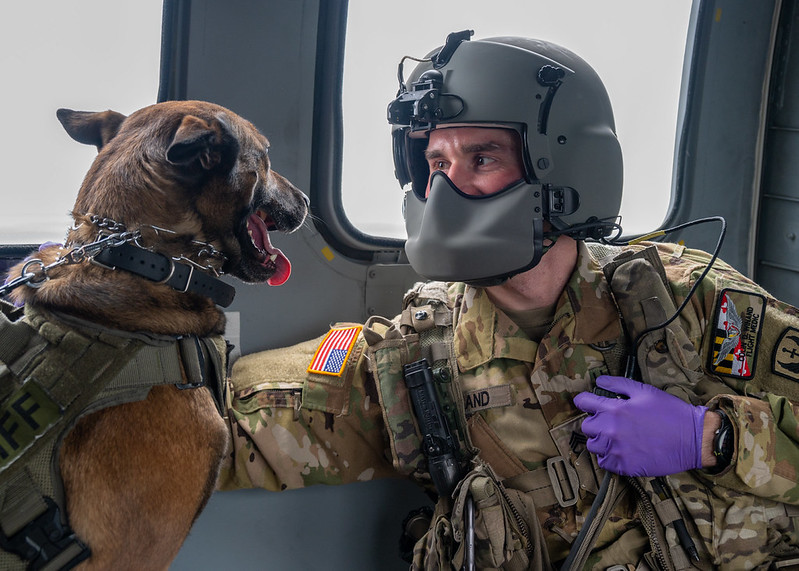
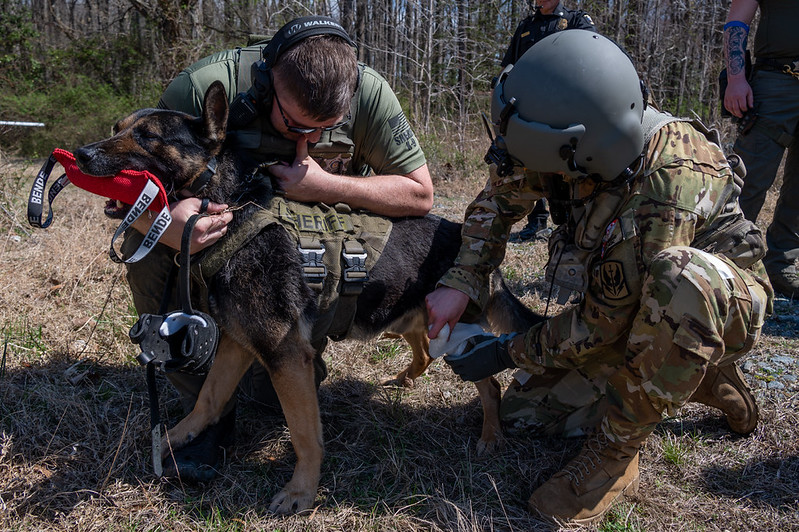
EDGEWOOD, Md.—Maryland Army National Guard soldiers conducted medical evacuation training with two UH-60 Black Hawk helicopters assigned to the 29th Combat Aviation Brigade, collaborating with local police K-9 units at Lauderick Creek Military Reservation, April 1, 2026.
The event involved 30 participants, including Guard members from Company C, 1st Battalion, 169th Aviation Regiment, officers from the Cecil County Sheriff’s Office and the Montgomery County Police, and eight police dogs. The primary goal for this collaboration was to integrate civilian law enforcement K-9 units into a medical evacuation exercise and enhance interagency operational effectiveness through shared learning scenarios.
“While I was deployed to Kosovo in 2021, there was a K-9 unit there, and I had been tasked with creating a K-9 medical bag,” said Maryland Army National Guard Staff Sgt. Joanna Adams, flight medic non-commissioned officer assigned to Company C, 1-169th Aviation Regiment. “I remember feeling that the training I had up to that point was inadequate for what I would need if there was an actual emergency involving a K-9. After I came back from deployment, I started looking into getting training for my unit with K-9s.”
Two scenarios took place simultaneously, involving a variety of simulated situations for Guard members, the police dogs, and their handlers.
One scenario focused on K-9 familiarization with helicopter operations, including the acoustic and environmental impacts of the aircraft. Service members practiced hoist operations with Montgomery County officers using a rescue seat and a plastic stretcher, often used for non-ambulatory or severely injured patients. Ground crewmembers were responsible for managing a tagline to prevent the stretcher from spinning during hoist operations.
“Our medics and crew chiefs enjoyed being able to use skills that we do not get to use very often, and we thoroughly enjoyed working with these civilian units,” said Adams. “The most rewarding thing I learned was that even when things were not going 100% the way I had planned, everyone was still learning, and sometimes the deviations were better than what the original plan was in the first place.”
This training event built upon a previous collaboration with officers of the Cecil County Sheriff’s Office, conducted last summer, in which K-9s and their handlers received initial familiarization with aircraft and practiced hoist operations using a basket lift.
During this exchange, officers provided valuable information on how to remove a K-9 from a bite in the event of handler incapacitation, as well as how to respond if accidentally bitten by a K-9 while administering aid.
“Not only do we have the fortune of building strong foundations in the units we serve in and are able to effect change over many years, but we also directly impact the community we live in,” said Maryland Army National Guard Staff Sgt. Colin Winand, flight paramedic non-commissioned officer assigned to Company C, 1-169th Aviation Regiment. “Knowing that I can assist my neighbors while completing missions makes the desired outcome that more important.”
Treating K-9s and their handlers in a real-world situation requires learning to assess vital signs and evaluate medication effectiveness. Mission success relied upon the medical team’s proficiency in a scenario that medics and aviators don’t often get the chance to practice or learn.
“It was really great to work with the police dogs and their handlers before a real-world emergency,” said Adams. “Knowing what works and what doesn’t is really important when working with animals before a bad day happens. I was really impressed with the dogs and the officers. They are very well-trained, so it makes it easy to work with them and determine best practices so we can be ready to respond for our state and nation when we are needed.”
