
MDEM Newsroom - Page 13 MDEM Newsroom
Governor Hogan Requests Presidential Disaster Declaration Following Damages Caused by Tropical Storm Isaias
September 3rd, 2020
State Agencies, Three Counties Would be Eligible for Reimbursements |
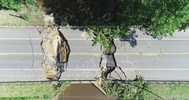 |
Reisterstown, MD (September 3, 2020) — Governor Larry Hogan today requested the White House issue a Major Disaster Declaration to assist communities impacted by Tropical Storm Isaias in August. The request, made through the Federal Emergency Management Agency (FEMA)’s Public Assistance disaster relief program, would provide financial assistance to Calvert, Dorchester and St. Mary’s counties and state agencies for repairs to public infrastructure, and reimburse for measures taken to prepare for and respond to last month’s storm.
“Tropical Storm Isaias caused significant damage in much of Maryland, especially in Southern Maryland and on the Eastern Shore,” said Gov. Hogan. “Federal funding will help state and local agencies recover from the impacts of the storm. These funds are especially important because the COVID-19 pandemic has had drastic impacts to local and state budgets.”
Because of the dire economic conditions in Maryland as a result of the COVID-19 outbreak, Gov. Hogan is asking the President to reimburse state and local agencies for 100 percent of eligible response and recovery efforts, rather than the typical local cost share which agencies simply cannot afford. The money will be used to reimburse costs of debris removal, the repair or replacement of uninsured public infrastructure and emergency protective measures, such as operating Emergency Operations Centers and first response. The state also is requesting hazard mitigation funding which will allow communities to make investments to lessen the impacts of future disasters.
“Isaias spawned 10 tornadoes in Maryland and also caused extensive flood and wind damage,” said Maryland Emergency Management Agency Executive Director Russ Strickland. “Many of the responding agencies have already been stretched thin because of the COVID-19 pandemic, so federal assistance is especially important.”
If the President grants a Major Disaster Declaration, state agencies, local governments, and certain non-profit organizations will be eligible to submit the cost of operations and projects to FEMA for reimbursement. State and local officials have been coordinating with FEMA since August to develop a complete picture of the extent of damage. While assessments continue, officials believe damages exceed the federal threshold for Maryland and the counties included in the request.
For more information about the Disaster Declaration process, please view this fact sheet.
###
CONTACT:
Ed McDonough, [email protected], 410-446-3333
Jorge Castillo, [email protected], 443-381-3518
24/7 line: 877-636-2872
MEMA Says “Thank You” to Marylanders for Keeping State Safe
September 1st, 2020
Preparedness Month is a Reminder that Hurricane Season is Hitting Peak, Other Hazards Loom |
 |
REISTERSTOWN, Md. (September 1, 2020) — September is Preparedness Month and the Maryland Emergency Management Agency (MEMA) wants to take this opportunity to thank our residents for their efforts to help keep our state safe and resilient. Whether it is wearing a mask and distancing yourself, following weather events or not driving through standing water, we truly appreciate your efforts.
“This has been a challenging year for all of us,” said MEMA Executive Director Russ Strickland. “I could not be more proud of the way my fellow Marylanders have responded, not only to the pandemic but for their general preparation for all threats and hazards. That spirit will serve us well as the 2020 Hurricane Season continues.“
This is shaping up to be one of the busiest seasons on record, and later summer-early fall is usually the busiest part of the season in the Mid-Atlantic region. It is vital that Marylanders remain vigilant and be prepared.
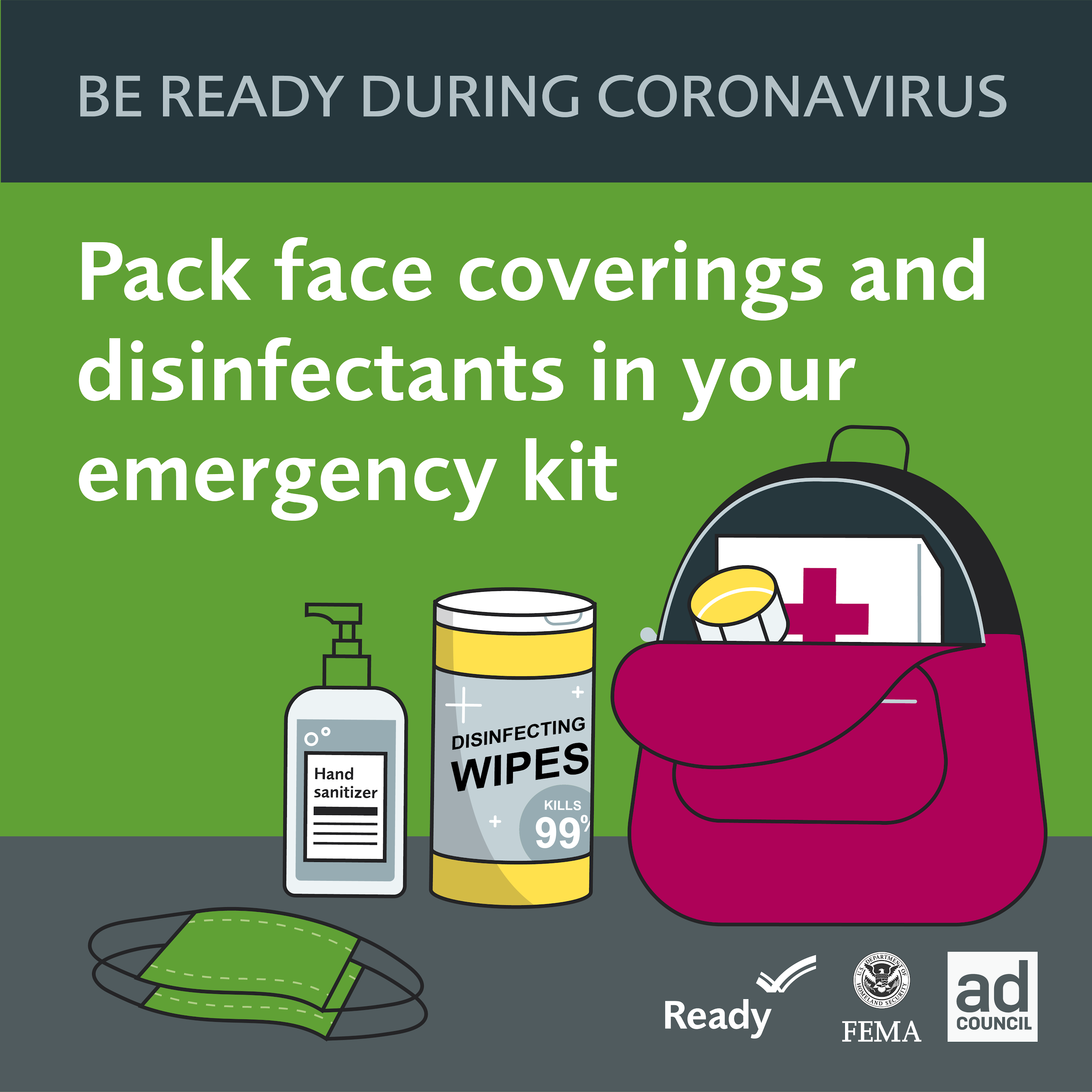
It is important to remember that COVID-19 means there will be changes to evacuation and sheltering plans and that your emergency supply kit needs to have extra items because of the pandemic. If you live, work or visit areas along the ocean, the Chesapeake Bay or its tributaries, it also is important to understand Maryland’s Know Your Zone hurricane evacuation plan. To learn more about the program and hurricane preparedness in Maryland, visit KnowYourZoneMD.com.
But pandemics and hurricanes are not the only hazards in Maryland. Flooding is the most common hazard in Maryland, and tornadoes, severe storms, dangerous heat, and severe winter storms are among the other potential hazards. We encourage all Marylanders to remain vigilant for all hazards that might affect you.
As part of Preparedness Month, MEMA, in conjunction with the Maryland Department of Health, and other agencies, will host various online live events to engage with Marylanders. Follow MEMA on Facebook or Twitter (@MDMEMA) to join these opportunities.
You can learn more about being prepared for any hazard from MEMA, the Federal Emergency Management Agency, the National Weather Service or the American Red Cross.
###
CONTACT:
Jorge Castillo, [email protected], 443-381-3518
Ed McDonough, [email protected], 410-446-3333
24/7 line: 877-636-2872
MEMA Expands Public Service Announcement Campaign as Maryland Prepares to Enter the Peak of Hurricane Season
August 21st, 2020
Urges Marylanders to Take Preparations Seriously Amidst COVID-19 Pandemic |
 |
REISTERSTOWN, Md. (August 21, 2020) — Know. Plan. Act. These are the actions Maryland Emergency Management (MEMA) officials are urging Marylanders to take as the Mid-Atlantic region prepares to enter the peak of hurricane season––one that has already broken several records, including a record 11 named storms thus far, with nine tropical storms and two hurricanes.
The Public Service Announcement (PSA) campaign launched through social media and digital billboards days before Isaias impacted Maryland and will be expanding to TV, radio, cable, and other mass media beginning today. The campaign underscores the importance of hurricane preparedness during COVID-19 and knowing if you are in, near, or traveling to, an evacuation zone by visiting KnowYourZoneMd.com.
“I urge all Marylanders to be proactive and take preparations for hurricane season seriously,” said Maryland Governor Larry Hogan. “Isaias showed us the kind of damage a tropical storm can do to our communities. All Marylanders need to be extra vigilant this hurricane season due to extra precautions that may need to occur due to the COVID-19 pandemic. The time to prepare is now.”
Isaias hit Maryland in early August, spawning 9 tornadoes on the Eastern Shore and in Southern Maryland, causing one death and several injuries and likely causing millions of dollars in damage.
NOAA’s updated 2020 Atlantic Hurricane Season Outlook forecasts that an “above-normal hurricane season is very likely, with a significant possibility of the season being extremely active.” Specifically, the outlook indicates an 85% chance of an above-normal season.
“There is a possibility according to NOAA that we will see a much more active hurricane season than what we are used to as Marylanders,” said MEMA’s Executive Director, Russ Strickland. “All it takes is one storm to change your life. That is why the State of Maryland, MEMA, local Emergency Management Directors, and our partners, like the American Red Cross, will continue to collaborate together through National Preparedness Month in September until the end of hurricane season in November, to ensure our preparedness message is heard loud and clear.”
Strickland also reminded Marylanders to Know, Plan, and Act.
- Know: Your zone in case you are told to evacuate by local emergency officials.
- Plan: what you need to do to deal with an emergency now.
- Act: Be familiar with evacuation areas, evacuate when ordered to do so.
As part of the ongoing PSA campaign in Maryland, MEMA has created eleven 30-second videos that cover all aspects of hurricane preparedness, including COVID-19 implications; hurricane threats, like storm surge and tidal flooding, flooding rains, hazardous winds, and tornadoes; evacuation zones and orders; emergency kit preparations; considerations for children and pets; and sheltering in place.
Preparing for the hurricane season––and all hazards––has become more challenging during the COVID-19 pandemic, for both emergency officials and the public. State and local officials, and their partners, have updated plans for both evacuation and sheltering because of COVID 19 limitations. MEMA reminds people of how COVID-19 may affect this year’s hurricane season in Maryland:
- People may be asked to shelter-in-place in lieu of evacuation in some circumstances, and if buses are provided to assist with evacuations, their capacity will be reduced.
- Allow extra time to evacuate if needed because shelters might be farther away.
- Residents are better off locating shelter with family or friends outside the expected danger zone or staying at an accommodation of their choice.
- Capacity at congregate shelters (i.e., schools) will be severely reduced and officials will explore using non-congregate shelters (i.e., hotels and rental properties) where available. But state, local, and nonprofit partners will still provide shelter options.
- Shelter operators also have stocked up on COVID-19 specific supplies such as face coverings, sanitizer, and disinfectant wipes, to augment what evacuees may not have. However, residents need to make added preparations to their disaster supply kit because of COVID 19:
- Face coverings — at least 2 per person.
- Hand sanitizer and disinfectant wipes.
- Look here for the complete list of recommended supplies and make sure you have extra supplies for your pets.
The above additional considerations are in addition to the preparedness steps you should already have been taking:
- Prepare and plan for surviving on your own after a disaster.
- Plan for several days without electricity, water service, access to a supermarket, banks or ATMs, and other local services.
- Take time to learn lifesaving skills, such as CPR and first aid. Also, know how to take practical safety steps like shutting off water and gas.
- Check your insurance policies and coverage for the hazards you may face, such as flood, earthquakes, and tornados. Make sure to consider the costs associated with disasters and try to save for an emergency.
- Being prepared starts by knowing your risk and taking the appropriate actions before, during, and after a disaster strikes.
- This means a communications plan, an evacuation & reconvening plan, and a plan for your pets.
- Learn where you will receive emergency notifications, including news media, a NOAA weather radio, the Emergency Alert System (EAS), etc. Learn about other alert systems at Ready.gov/alerts.
- Plan to be able to receive Information from federal, state, local, tribal, and territorial resources.
- Follow MEMA and your local emergency management agency on social media.
For more information about hurricane preparedness, please visit MEMA, Ready.gov, the National Weather Service, and the American Red Cross. To receive alerts, tips, and resources related to COVID-19 and other threats and hazards affecting or that may affect Maryland during this hurricane season and beyond, text “MdReady” to 898211.
NOTE TO MEDIA: MEMA staff will be available to arrange interviews for your article, story or public affairs show. Please contact us at the email below.
###
CONTACT:
Maryland State Emergency Operations Center PIO: [email protected]
MEMA Calls for Continued Vigilance and Preparedness as Isaias Impacts Maryland Early This Week
August 2nd, 2020
Prepare for Possible Power Outages, Include COVID-19 in Plans, and Know Your Zone |
 |
REISTERSTOWN, Md. (August 2, 2020) — The Maryland Emergency Management Agency (MEMA) and affiliated state agencies are closely monitoring Tropical Storm Isaias as it heads toward Maryland. Even though the storm is currently not a hurricane, Marylanders should be prepared for potential flooding, tidal surge in low lying areas, and tropical storm force winds (greater than 39 miles per hour).
“Please don’t let your guard down just because Isaias is no longer a hurricane,” said Russ Strickland, MEMA’s Executive Director. “Be prepared for potential power outages, flash floods and tidal flooding. This is still a dangerous system.”
At this time, it appears the lower Eastern Shore and Southern Maryland will be the hardest hit areas, with the heavily populated central region also expected to be affected. However, a slight shift westward of the storm track could bring heavy rain to parts of western Maryland. Regardless of location, most Marylanders can expect to feel some effects from Isaias.
MEMA also reminds Maryland residents to make sure emergency kits include at least 2 face coverings for each person, hand sanitizer, disinfectants, and other COVID-19 related supplies in addition to the usual disaster supply kit components.
During the COVID-19 pandemic it’s more important than ever to pay attention to the hazards of hurricane season. As a Marylander or as a visitor to Maryland, you should Know Your Zone to see if the places you live, work, or visit are in one of Maryland’s three evacuation zones. The Know Your Zone program allows local emergency officials to order evacuations by letter zones (A, B and C). To learn more about Know Your Zone or to see if you might be in an evacuation zone, please click here.
Remember that even if you are not in one of the Maryland evacuation zones, you could still feel the effects of hurricanes and other hazards. Hurricanes can spawn flash floods, severe thunderstorms, and tornadoes many miles away form the eye of the storm and 100 miles or more inland.
Here are some additional considerations while planning for hurricanes and other hazards during the COVID-19 pandemic:
- If you must evacuate, bring items such as hand sanitizer, cleaning materials, and two cloth face coverings per person. Children under 2 years old, people who have trouble breathing, and people who cannot take the cloth face covering off without help should not wear cloth face coverings.
- Pay attention to emergency information and alerts from official sources.
- Keep devices charged in case of possible power outages.
- Know who to contact if you lose power. A list of contact information for power utilities in Maryland can be found here.
- Determine your best protection for high winds and flooding.
- Keep in mind that your best protection from the effects of a hurricane may differ from your best protection from disease.
- Unless you live in an evacuation zone, make a plan to shelter-in-place in your home, if it is safe to do so.
- Check with local authorities for the latest information about public evacuation shelters.
- Only use generators outdoors and never in a garage. The generator should be at least 20 feet away from your home and away from windows, doors, and vents.
- Do not walk, swim, or drive through flood waters.
It is also important to allow extra time to evacuate if needed because shelters might be farther away. As always, residents are better off locating shelter with family or friends outside the expected danger zone or staying at an accommodation of their choice. But state, local, and nonprofit partners will still provide shelter options.
For more information about hurricane preparedness, please visit MEMA, FEMA, the National Weather Service and the American Red Cross.
To receive alerts, tips, and resources related to COVID-19 and other threats and hazards affecting or that may affect Maryland during this hurricane season and beyond, text “MdReady” to 898211.
###
CONTACT:
Maryland State Emergency Operations Center PIO: [email protected]
Marylanders Urged to Monitor Hurricane Isaias, Which Could Impact Maryland Early Next Week
July 31st, 2020| Now is the Time to Update Supply Kit, Include COVID-19 in Plans, and Know Your Zone |  |
REISTERSTOWN, Md. (July 31, 2020) —The Maryland Emergency Management Agency (MEMA) encourages all Marylanders to monitor Hurricane Isaias and make plans now in case the storm impacts the Mid-Atlantic region. Forecasters remain uncertain about the exact track of the storm, but some models show it will affect parts of Maryland as soon as Monday evening of next week as it moves northward.The range of hazards that could affect Maryland is still broad – ranging from little impact, to Isaias bringing flooding rains and tropical storm force winds to central and eastern Md.
“Now is the time to make sure you are ready for possible effects from Hurricane Isaias,” said Russ Strickland, MEMA’s Executive Director. “The COVID-19 pandemic adds another layer of complexity during a tropical storm or hurricane, and that means there may be changes to normal evacuation and sheltering plans,” he added.
MEMA also reminds Maryland residents to make sure emergency kits include at least 2 face coverings for each person, hand sanitizer, disinfectants, and other COVID-19 related supplies in addition to the usual disaster supply kit components.
During the COVID-19 pandemic it’s more important than ever to pay attention to the hazards of hurricane season. As a Marylander or as a visitor to Maryland, you should Know Your Zone to see if the places you live, work, or visit are in one of Maryland’s three evacuation zones. The Know Your Zone program allows local emergency officials to order evacuations by letter zones (A, B and C). To learn more about Know Your Zone or to see if you might be in an evacuation zone, please click here.
Remember that even if you are not in one of the Maryland evacuation zones, you could still feel the effects of hurricanes and other hazards. Hurricanes can spawn flash floods, severe thunderstorms, and tornadoes many miles away form the eye of the storm and 100 miles or more inland.
Here are some additional considerations while planning for hurricanes and other hazards during the COVID-19 pandemic:
- If you must evacuate, bring items such as hand sanitizer, cleaning materials, and two cloth face coverings per person. Children under 2 years old, people who have trouble breathing, and people who cannot take the cloth face covering off without help should not wear cloth face coverings.
- Pay attention to emergency information and alerts from official sources.
- Determine your best protection for high winds and flooding.
- Keep in mind that your best protection from the effects of a hurricane may differ from your best protection from disease.
- Unless you live in an evacuation zone, make a plan to shelter-in-place in your home, if it is safe to do so.
- Check with local authorities for the latest information about public evacuation shelters.
- Only use generators outdoors and never in a garage. The generator should be at least 20 feet away from your home and away from windows, doors, and vents.
- Do not walk, swim, or drive through flood waters.
It is also important to allow extra time to evacuate because shelters might be farther away. As always, residents are better off locating shelter with family or friends outside the expected danger zone or staying at an accommodation of their choice. But state, local, and nonprofit partners will still provide shelter options.
For more information about hurricane preparedness, please visit MEMA, FEMA, the National Weather Service and the American Red Cross.
To receive alerts, tips, and resources related to COVID-19 and other threats and hazards affecting or that may affect Maryland during this hurricane season and beyond, text “MdReady” to 898211.
###
CONTACT:
Maryland State Emergency Operations Center PIO: [email protected]
Be Prepared for the Effects of COVID-19 on 2020 Hurricane Season
June 10th, 2020| Coronavirus Concerns May Change Sheltering and Evacuation Plans; Make Sure Your Kit has Masks, Other Safety Gear; Remember to Know Your Zone |  |
Reisterstown, Md. (June 10, 2020) — The Maryland Emergency Management Agency (MEMA) is updating response procedures to include COVID-19 components as it plans for the 2020 hurricane season, and encourages Maryland residents to do the same. Disasters will not wait because of the SARS-CoV-2, the virus that causes COVID-19, and evacuation, sheltering, and access to essential preparedness items will be different than in years past.
“We all need to take a closer look at our hurricane preparedness because of COVID-19,” said Russ Strickland, MEMA executive director. “It is more important than ever to make sure you have a family emergency plan and be ready to follow the directions of local emergency officials.”
MEMA has been working with other state agencies, local, and federal partners to update hurricane —and all natural hazards— plans for the months ahead. Planners are working to identify shelters with less open space and more individual rooms, such as hotels and motels, apartments and rental properties.
It also may be important to allow extra time to evacuate because shelters might be farther away. As always, you are better off locating shelter with family or friends outside the expected danger zone or stay at an accommodation of your choice. But state, local, and nonprofit partners will still provide shelter options.
We also understand that many people are under financial and psychological stress because of COVID-19, and the start of hurricane season can add to that stress. One way to alleviate some stress is to prepare ahead and plan for things you can control.
Make sure you have a plan if you need to evacuate, prepare a disaster supply kit to the best of your ability, and follow weather information so you will know if a tropical weather system is headed toward the Middle Atlantic region. You should also make sure the supply kit has adequate masks and hand sanitizer for everyone in your evacuation group.
Marylanders also should Know Your Zone to see if the places you live, work or visit are in one of Maryland’s three evacuation zones. The Know Your Zone program allows local emergency officials to order evacuations by letter zones (A, B and C). To learn more about Know Your Zone or to see if you might be in an evacuation zone, please click here.
Remember that even if you are not in one of the Maryland evacuation zones, you could still feel the effects of hurricanes and other hazards. Hurricanes can spawn flash floods, severe thunderstorms, and tornadoes many miles away form the eye of the storm and 100 miles or more inland.
Here are some additional considerations while planning for hurricanes and other hazards during the COVID-19 pandemic:
- If you must evacuate, bring items such as hand sanitizer, cleaning materials, and two cloth face coverings per person. Children under 2 years old, people who have trouble breathing, and people who cannot take the cloth face covering off without help should not wear cloth face coverings.
- Pay attention to emergency information and alerts.
- Determine your best protection for high winds and flooding.
- Keep in mind that your best protection from the effects of a hurricane may differ from your best protection from disease.
- Unless you live in an evacuation zone, make a plan to shelter-in-place in your home, if it is safe to do so.
- If you live in a mandatory evacuation zone, make a plan with friends or family to shelter with them where you will be safer and more comfortable.
- Check with local authorities for the latest information about public evacuation shelters.
- Only use outdoor generators that are at least 20 feet away from your home and away from windows, doors, and vents.
- Do not walk, swim, or drive through flood waters.
For more information about hurricane preparedness, please visit MEMA, FEMA, the National Weather Service and the American Red Cross.
To receive alerts, tips, and resources related to COVID-19 and other threats and hazards affecting or that may affect Maryland during this hurricane season and beyond, text “MdReady” to 898211.
###
CONTACT:
MD COVID-19 Joint Information Center, [email protected]
24/7 line: 877-636-2872
Maryland Business Emergency Operations Center Delivers Crucial Intelligence, Guidance to Maryland Businesses During Global Pandemic
April 23rd, 2020Vision, Collaboration, and Reliability are MEMA’s Core Values
 REISTERSTOWN, Md. (April 23, 2020) — During emergencies and disasters, close collaboration between the Maryland Emergency Management Agency (MEMA) and the private sector is critical in protecting citizens and rebuilding communities. The Maryland Business Emergency Operations Center (MBEOC) is MEMA’s two-way conduit for information sharing between public and private sector stakeholders.
All Maryland businesses are encouraged to find out more information on the MBEOC and MEMA’s Private Sector Integration Program (PSIP) and to consider joining. Signing up is easy and only takes a few minutes. Please visit https://mema.maryland.gov/community/Pages/PSIP-Welcome.aspx
“Public-private partnerships are an essential component of MEMA’s vision to shape a more resilient Maryland where communities thrive,” said Russ Strickland, MEMA’s Executive Director. “Relationships must be built and fostered before an emergency, and that is essential to what we do. Our commitment to businesses in Maryland does not start with an MBEOC activation, rather, we have been working with the private sector and preparing for all hazards as part of MEMA’s Private Sector Integration Program to be ready for an emergency such as the COVID-19 global pandemic.”
The MBEOC is an operational information sharing structure created to enhance communications and collaboration with private industry partners and ensure their integration into disaster operations at a strategic and tactical level.
The MBEOC works to:
- Assist MEMA’s State Coordinating Function Liaisons by identifying potential sources of operational support and providing situational awareness during response and recovery phases of a disaster.
- Improve situational awareness across affected areas and facilitate information sharing between public and private sectors on existing needs and capabilities during a disaster.
- Engage key stakeholders who can bring resources, capabilities, and expertise to support disaster response and recovery operations.
- Coordinate requests for information about critical infrastructure sectors through through the United States Department of Homeland Security Critical Infrastructure and Security Agency’s (CISA) National Infrastructure Coordination Center (NICC).
- Foster mutually-supportive relationships that strengthen public-private partnerships.
To this date, the MBEOC in partnership with the Maryland Department of Commerce has been able to:
- Identify vendors for COVID-19 emergency response.
- Coordinate donations of products and services with submitted requests of need.
- Conduct regular coordination calls with PSIP members to share information and answer incident specific questions while coordinating with the Governor’s office and other state level elected officials.
- Serve as the operational conduit between business and government.
During incidents the MBEOC provides a Daily Situational Report with timely information to its members in order to assist them with daily planning and emergency response operations. For a comprehensive exchange of information, the MBEOC institutes a twice a week call to engage the State’s PSIP members and grant them the opportunity to brief out operational information on industry, success stories, issues at hand, and future supply chain concerns. These calls collect information to assist with State operations and future supply chain interruption.
Below are some of the MBEOC success stories with PSIP partners:
- Maryland Beverage Association donated Power Bars to Maryland Food Bank. Coordination occurred through MBEOC and the Maryland Department of Human Services.
- Maryland Retailers Association encouraged the increase of the allotment of the maximum purchasing limit for childcare centers or providers with Maryland State Department of Education’s Office of Childcare.
- Maryland Retailers Association communicated enforcement concerns about state and local executive orders.
- PSIP Partners Walgreens and CVS approved Department of Aging government purchasing cards in their stores.
- National Federation of Independent Businesses (NFIB) small business partners in Maryland have been able to assist with State procurement requests, specifically tents, for temporary medical service locations.
- Rumor control and guidance on communication to industry regarding COVID-19.
###
CONTACT:
MD COVID-19 Joint Information Center, [email protected]
Your Donations are Needed, Please Help If You Can
April 10th, 2020Your help is needed to keep our medical professionals safer on the front lines. Please consider safely donating, if you can. “If we all do our part to rise to this challenge and to meet this moment, we will get through this together.” ~ Governor Larry Hogan
Necesitamos su ayuda para mantener a nuestros profesionales médicos de primera línea protegidos. Por favor, si puede, considere donar de manera segura. “Si todos hacemos nuestra parte para enfrentar este desafío y enfrentar este momento, lo superaremos juntos”. ~ Gobernador Hogan
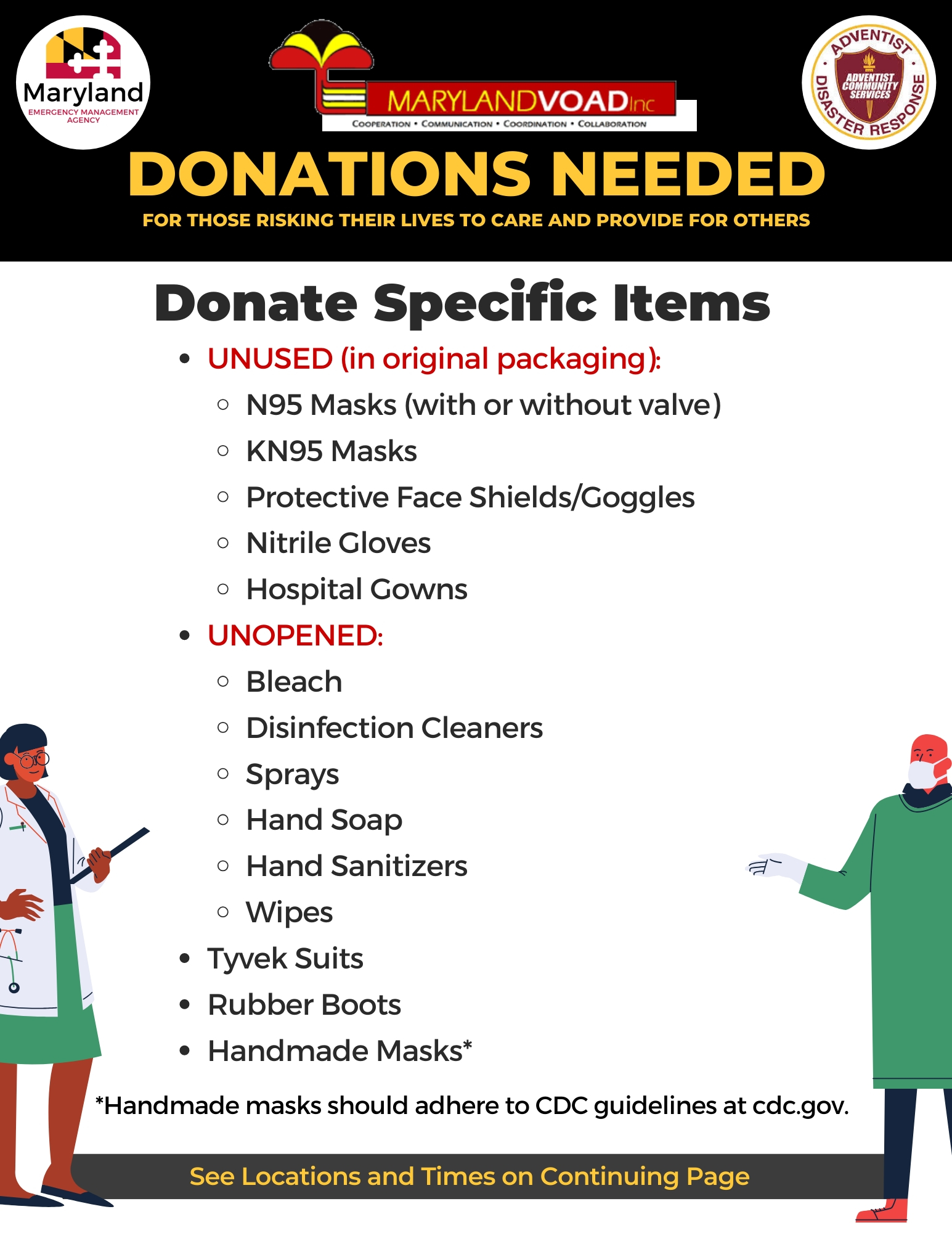
Image description:
Donations Needed for those risking their lives to care and provide for others. Donate Specific Items.
- UNUSED (in original packaging):
- N95 Masks (with or without valve)
- KN95 Masks
- Protective Face Shields/Goggles
- Nitrile Gloves
- Hospital Gowns
- UNOPENED:
- Bleach
- Disinfection Cleaners
- Sprays
- Hand Soap
- Hand Sanitizers
- Wipes
- Tyve
- Suits
- Rubber Boots
- Handmade Masks*
*Handmade masks should adhere to CDC guidelines at cdc.gov.
See Locations and Times on Continuing Page
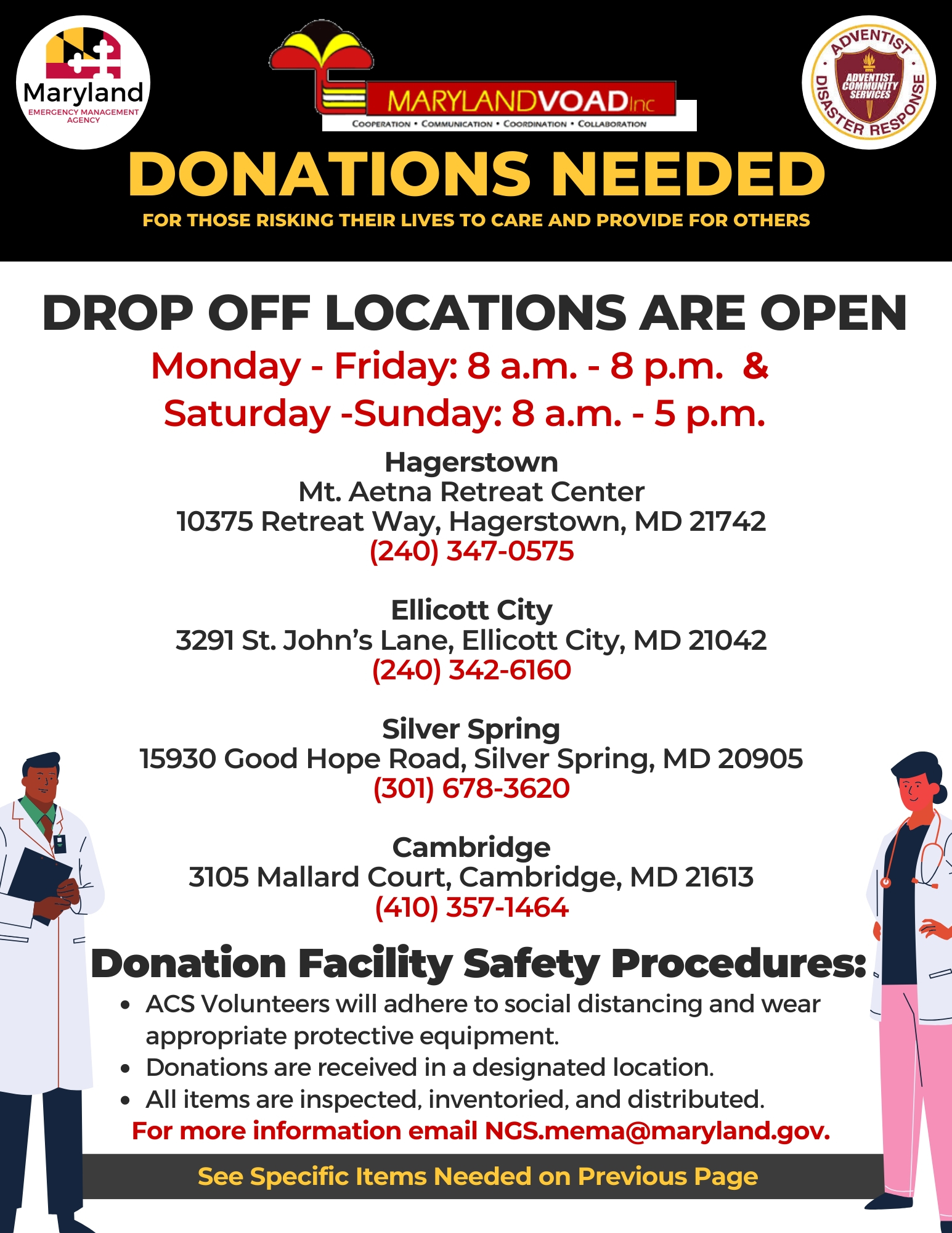
Image description:
Donations Needed for those risking their lives to care and provide for others.
Drop off Locations are open.
Monday – Friday: 8 a.m. – 8 p.m. &
Saturday – Sunday: 8a.m. – 5p.m.
Hagerstown
Mt. Aetna Retreat Center
10375 Retreat Way, Hagerstown, MD 21742
(240) 347-0575
Ellicott City
3291 St. John’s Lane, Ellicott City, MD 21042
(240) 342-6160
Silver Spring
15930 Good Hope Road, Silver Spring, MD 20905
(301) 678-3620
Cambridge
3105 Mallard Court, Cambridge, MD 21613
(410) 357-1464
Donation Facility Safety Procedures:
- ACS Volunteers will adhere to social distancing and wear appropriate protective equipment.
- Donations are received in a designated location.
- All items are inspected, inventoried, and distributed.
For more information email [email protected].
See Specific Items Needed on Previous Page

Image description:
SE NECESITAN DONACIONES
PARA LOS QUE ARRIESGAN SUS VIDAS POR CUIDAR Y PROVEER A LOS DEMÁS
Donaciones de Artículos Específicos
- SIN USO (en su empaque original):
- Mascaras N95 (con o sin válvula)
- Protectores Faciales
- Gafas de Protección
- Guantes de Nitrilo
- Batas de Hospital
- SIN ABRIR:
- Cloro
- Limpiadores Desinfectantes
- Sprays
- Desinfectantes de Manos
- Paños Húmedos Desifentactes
- Trajes Tyvek
- Botas de Goma
- Mascarillas Hechas a Manos*
*Las máscaras hechas a mano deben adherirse a las
regulaciones del CDC en cdc.gov.
Vea Lugares y Horarios en la página siguiente
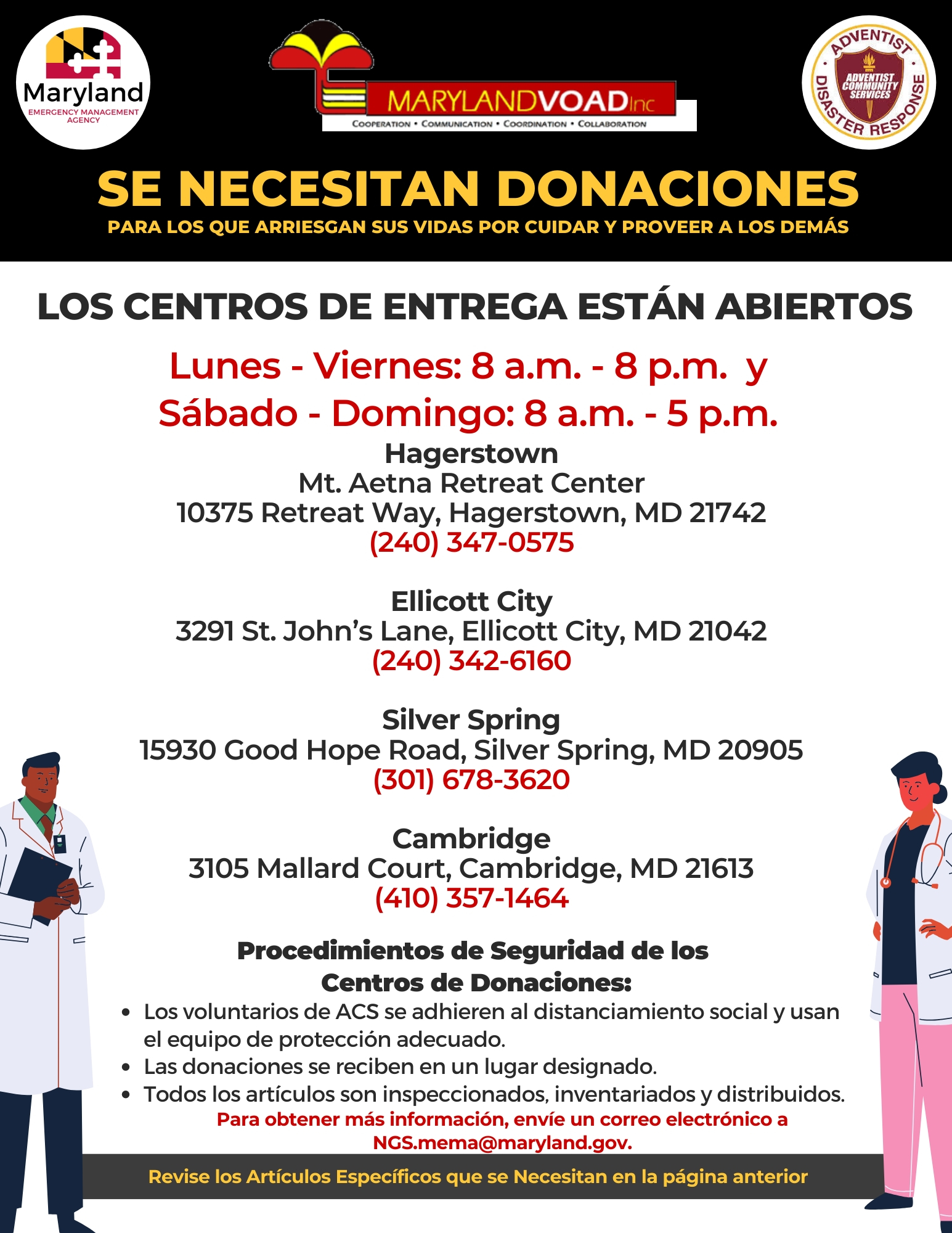
Image description:
SE NECESITAN DONACIONES
PARA LOS QUE ARRIESGAN SUS VIDAS POR CUIDAR Y PROVEER A LOS DEMÁS
LOS CENTROS DE ENTREGA ESTÁN ABIERTOS
Lunes – Viernes: 8 a.m. – 8 p.m. y
Sábado – Domingo: 8 a.m. – 5 p.m.
Hagerstown
Mt. Aetna Retreat Center
10375 Retreat Way, Hagerstown, MD 21742
(240) 347-0575
Ellicott City
3291 St. John’s Lane, Ellicott City, MD 21042
(240) 342-6160
Silver Spring
15930 Good Hope Road, Silver Spring, MD 20905
(301) 678-3620
Cambridge
3105 Mallard Court, Cambridge, MD 21613
(410) 357-1464
Procedimientos de Seguridad de los
Centros de Donaciones:
- Los voluntarios de ACS se adhieren al distanciamiento social y usan el equipo de protección adecuado.
- Las donaciones se reciben en un lugar designado.
- Todos los artículos son inspeccionados, inventariados y distribuidos.
Para obtener más información, envíe un correo electrónico a [email protected].
Revise los Artículos Específicos que se Necesitan en la página anterior
Maryland Coronavirus (COVID-19) Rumor Control Page Launches
April 7th, 2020Empowers Marylanders to Call Out False Information, Promote Facts
REISTERSTOWN, Md. (April 7, 2020) —The Maryland Emergency Management Agency (MEMA), in partnership with the Maryland Department of Health (MDH), and the Maryland Department of Information Technology (DoIT), today launched the Maryland Coronavirus (COVID-19) Rumor Control Page. Marylanders are encouraged to visit the page at Bit.ly/Md-Covid19-Rumors.
“As part of the State Response to COVID-19, MEMA stood up its Joint Information Center to provide the right information to the right people at the right time so they can be empowered to make the right decisions,” said Jorge E. Castillo, MEMA’s spokesperson. “We have been dispelling rumors and providing factual information since then, and we want Maryland residents to be able to participate in the process by helping us identify rumors and false information that could unnecessarily cause panic or worse, result in decision making that could lead to severe injuries or even death.”
Maryland’s Rumor Page allows visitors to:
- Read through several existing rumors and find the correct information in a variety of topics, including
- The Novel Coronavirus and the disease it causes, COVID-19
- Maryland and Federal Government Orders
- Supplies
- School / Education
- Subscribe to updates to be notified immediately once a new rumor has been identified and dispelled.
- Ask a question.
- See a digest of trusted sources and see their latest and most relevant social media posts in real time.
- Share the page easily to Facebook, Twitter, email, and more.
“If you see something, say something,” continued Castillo. “You can say it by clicking on the Submit a Rumor button on the right side of the page.”
###
CONTACT:
Maryland COVID-19 Joint Information Center: [email protected]
Hours Expand for Medical, Cleaning Supply Donations
April 3rd, 2020REISTERSTOWN, Md. (April 2, 2020) — Disaster relief agencies have extended the operating hours of the four locations around the state to accept donations of specialized medical equipment and some cleaning supplies to support COVID-19 response efforts. Maryland Volunteer Organizations Active in Disasters (VOAD) and the Adventist Community Services (ACS) have partnered to coordinate the collection and dissemination of these vital supplies. These efforts are in support of and in coordination with the Maryland Emergency Management Agency and other state agencies who are responding to the COVID-19 outbreak.
The four donation drop-off locations in Maryland, with contact information for those with questions, are as follows:
- Cambridge – (410) 357-1463: 3105 Mallard Court, Cambridge, MD 21613 Visible from Route 50. Drop off in the parking circle.
- Ellicott City – (240) 342-6160 3291 St. John’s Lane, Ellicott City, MD 21042
- Hagerstown – (240) 347-0575: Mt. Aetna Retreat Center, 10375 Retreat Way, Hagerstown, MD 21742 May also be listed as 21905 Mt. Aetna Road.
- Silver Spring – (301) 678-3620: 15930 Good Hope Road, Silver Spring, MD 20905 Corner of Route 198 and Good Hope Road. Entrance right off of Good Hope Road, lower parking lot.
The updated hours for these locations are:
- Monday through Friday: 8 a.m. – 8 p.m.
- Saturday & Sunday: 8 a.m. – 5 p.m.
Officials will ONLY accept the following items:
- Unused N95 masks with or without valve
- Protective face shields/goggles in original packaging
- Unused nitrile gloves in original packaging
- Unused hospital gowns in original packaging
- Tyvek suits
- Rubber boots
- Bleach – must be unopened and unused
- Disinfectant cleaners, sprays, and wipes– must be unopened and unused
- Hand soap
- Hand sanitizer
- Respirators
- Surgical Caps
Handmade, prototype, or unapproved personal protective equipment WILL NOT be accepted. Food and household donations also WILL NOT be accepted. In addition, DO NOT bring cash to these locations. Residents are encouraged to send monetary donations to local nonprofits and churches for support during this challenging time.
ACS volunteers will be wearing appropriate protective equipment (such as masks and gloves) when donations are received and will adhere to all social distancing guidelines. A specific identified place at each location is designated to receive donations. Items will then be inspected, inventoried, and distributed.
The warehouses are being operated in compliance with all orders from Governor Larry Hogan, which allows for the operation of “any non-profit organization or facility providing essential services to low income persons, including, without limitation, homeless shelters, food banks, and soup kitchens.“
The following information can also be found in Spanish, here. An accessible Spanish document is available upon request.
Members of the public with any questions about this program should contact [email protected].
###
CONTACT:
MD-COVID-19 Joint Information Center, [email protected], 410-517-5199