
Maryland Strengthens Emergency Communications through Statewide Interoperability Efforts
Statewide Interoperability Executive Committee Reconvenes To Guide Emergency Communications Policy Across Maryland
HANOVER, Md. (April 27, 2026) — The Statewide Interoperability Executive Committee (SIEC) reconvened at Maryland Department of Emergency Management (MDEM) headquarters today to set statewide interoperability priorities, identify voice and data communications capabilities and opportunities, and begin the process of revising the 2022 Maryland State Communications Interoperability Plan (SCIP) in order to advance improvements in communications for Maryland’s emergency responders throughout the state.
“Today’s meeting was another great step toward ensuring that interoperable public safety communications foster effective preparedness, response, and recovery activities,” said MDEM’s Secretary Russ Strickland. “A resilient Maryland depends on our ability to communicate without barriers during emergencies, and interoperability ensures that responders across agencies and jurisdictions can operate as one team, making faster decisions and delivering coordinated support when it matters most. Through the work of the Statewide Interoperability Executive Committee and MDEM, we are building a stronger, more connected emergency response system for all Marylanders.”
When Governor Wes Moore signed Executive Order 01.01.2024.20, he reestablished the SEIC and charged it with providing governance for “public safety emergency communications interoperability, and to promote the efficient and effective use of resources for matters related to public safety emergency communications and interoperability.” This action builds on earlier statewide efforts to formalize governance, strengthen coordination among state and local partners, and expand Maryland’s interoperable communications capabilities, positioning the State to advance these priorities through the 2026 Workplan.
“The SIEC will launch the process to revise the 2022 Maryland State Communications Interoperability Plan (SCIP),” said Jack Markey, MDEM’s Assistant Secretary and Statewide Interoperability Coordinator. “This process will develop strategic, consensus recommendations to enhance public safety voice and data interoperability, reduce costs and technical risks where possible, and also increase reliability and effectiveness.”
Operational communications form the backbone of emergency management. Responders from different agencies and jurisdictions need to be able to communicate clearly and reliably when it matters most. In Maryland, MDEM provides statewide leadership for interoperability by bringing together local, state, and federal partners to align systems, standards, and planning efforts. This collaborative approach does not involve operating individual communications systems, but instead focuses on ensuring they work together effectively during emergencies. Through this coordination, systems such as the FirstNet Public Safety Broadband Network (FirstNet) and the Maryland FiRST radio system, operated by partner agencies, are better integrated across jurisdictions. The result is stronger coverage, faster information sharing, and more effective response for all Marylanders.
Be sure to follow MDEM’s social media feeds on X (Twitter) (@MDMEMA), Facebook (facebook.com/MDMEMA), Linkedin (linkedin.com/company/maryland-department-of-emergency-management), Threads (threads.net/@mdmema) and Bluesky (@mdmema.bsky.social).
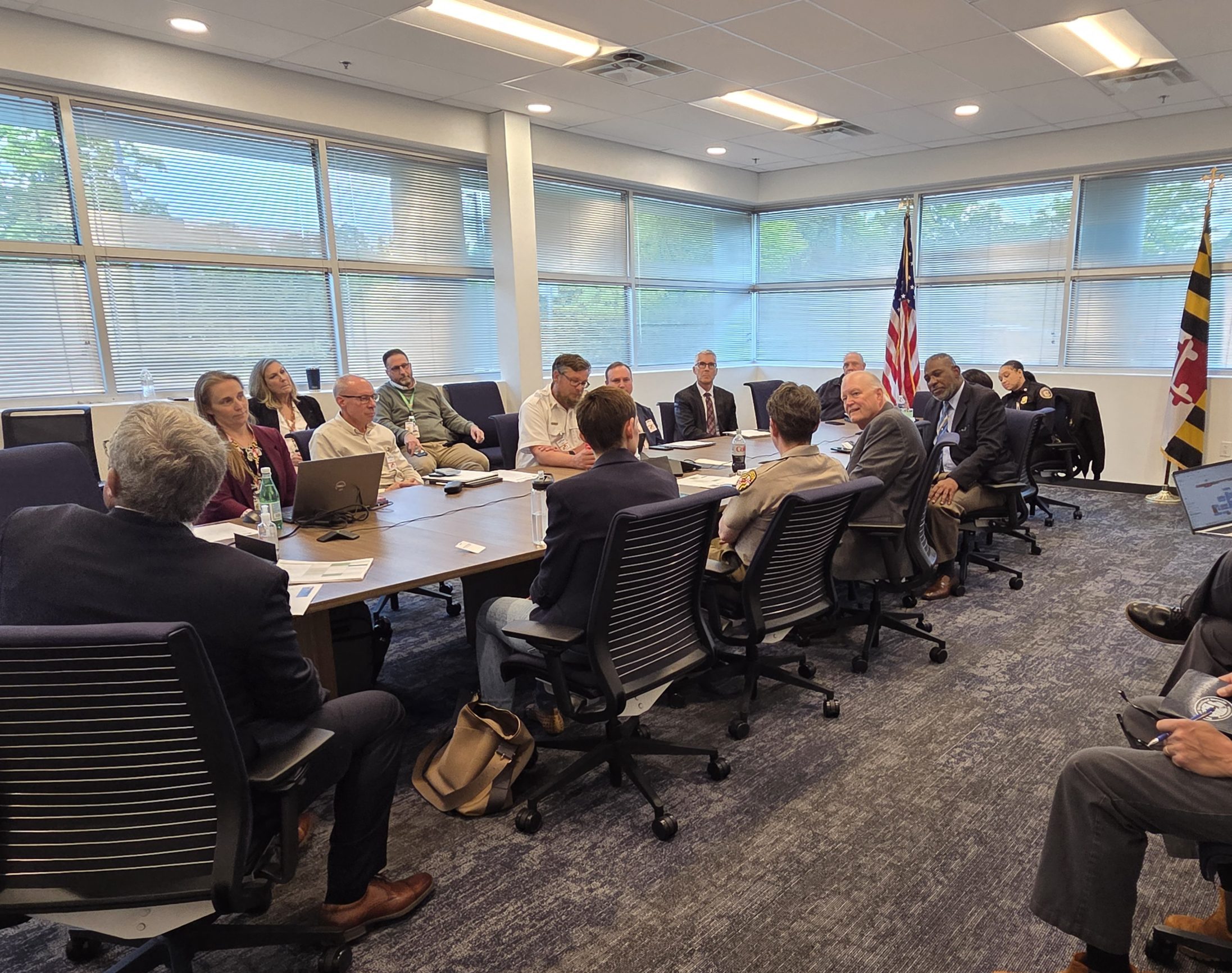
Sec. Strickland sits with the reconvened Statewide Interoperability Executive Committee to guide Emergency Communications Policy across Maryland.
***END***