
Eighth Annual Maryland Winter Safety Week Begins
MDEM, FEMA, NWS, State Agencies Partner to Increase Public’s Awareness of Winter Hazards
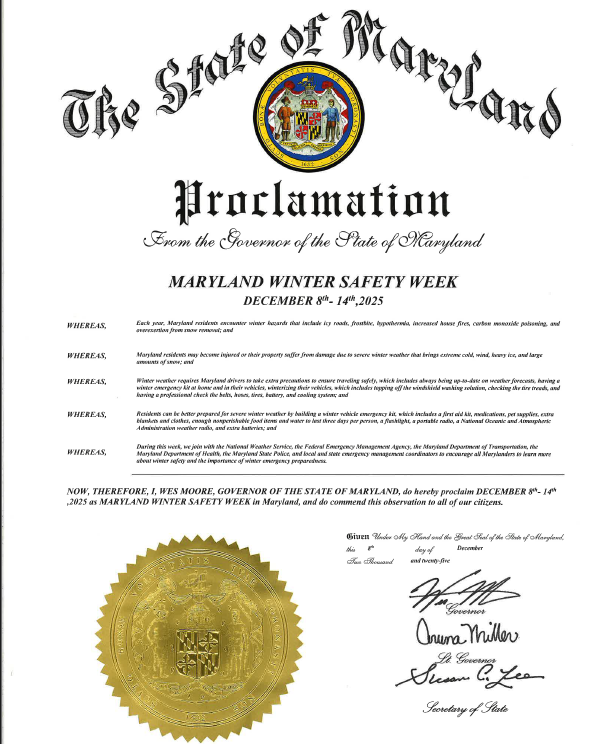
| HANOVER, MD (December 8, 2025) — Governor Wes Moore has proclaimed December 8 through 14, 2025 as Maryland Winter Safety Week, marking the eighth year of a statewide initiative to help Marylanders prepare for, respond to, and stay safe during winter weather. The Maryland Department of Emergency Management (MDEM) is once again partnering with the National Weather Service (NWS), The Federal Emergency Management Agency (FEMA), the Maryland Department of Transportation (MDOT), the Maryland Department of State Police (MDSP), and other State and local agencies to increase public awareness of winter hazards and promote practical preparedness steps.MDEM Secretary Russ Strickland underscored the need for advance preparation. “Each winter brings hazards that can result in injuries, loss of life, and costly damage here in Maryland,” Strickland said. “That’s why during Maryland Winter Safety Week MDEM and our partners are stressing the importance of being informed about winter hazards and what you can do to stay safe. Winter preparedness is part of what it means to be a Marylander and taking winter safety precautions seriously helps protect us all.”
Building a culture of preparedness in Maryland means weaving readiness into daily life. It’s checking in on neighbors, staying up to date on alerts, and making sure we know what to do when severe weather rolls in. Whether we find ourselves at home, work, or school, when Marylanders make preparedness part of their routine, they help each other stay safe, bounce back quicker, and stand together when things get tough. “MDEM is committed to help shape a more resilient Maryland where communities thrive,” Strickland added. “This winter, the best way to stay safe is simple: have multiple ways to get alerts, stay informed, and stay ready.” |
|
|
Weeklong Awareness Campaign
Throughout Maryland Winter Safety Week, MDEM and its partners will share safety information, preparedness tips, and interactive content across MDEM’s social media channels. This year’s campaign highlights:
- Cold-related health risks: Long exposure to extreme cold can weaken the immune system and worsen chronic conditions like asthma, arthritis, and diabetes. Vulnerable populations, including older adults and people with access and functional needs, are at especially high risk.
- Indoor heating and carbon monoxide safety: Winter brings an increase in carbon monoxide poisonings due to improper use of generators, gas stoves, or poorly maintained heating systems. If a space is unsafe for running a gas-powered tool, it is unsafe for a generator.
- Home fire safety: Residents are encouraged to use space heaters, cooking appliances, and holiday decorations safely, and to test smoke and carbon monoxide alarms regularly. Battery-operated flameless candles are a safer alternative to open flames.
- Winter travel safety: Snow, ice, and freezing rain can make driving extremely hazardous. MDEM reminds drivers to winterize vehicles and carry an emergency kit in their vehicle.
Practical Preparedness Steps
Taking small, simple steps that can make a big difference:
- Build a winter emergency kit for your vehicle. Include first aid supplies, medications, extra warm clothing, blankets, water, a flashlight, a portable radio, batteries, sand or cat litter for traction, and non-perishable snacks.
- Have ice melt, snow shovels, and sand readily available so you can safely clear walkways and prevent falls after freezing rain or snow.
- Prepare your home for severe cold by keeping a three-day supply of water, shelf-stable food, and essential medications in case travel becomes unsafe.
- Have safe ways to stay warm during severe cold. Keep extra blankets available, dress in layers, and identify a nearby warming center or a friend or family member you can stay with if you lose power.
- Stay connected and informed. Residents should have multiple ways to receive emergency alerts. Sign up for your local county and municipal emergency notification systems for your home and workplace locations.
- Use 211-Maryland. The statewide resource database offers more than 7,500 health and human service resources. Marylanders can call 211 anytime, in more than 150 languages, for assistance.
Additional information about winter preparedness can be found on our website (www.mdem.maryland.gov), X (Twitter) (@MDMEMA), Facebook (facebook.com/MDMEMA), Linkedin (linkedin.com/company/maryland-department-of-emergency-management), Threads (threads.net/@mdmema), YouTube site and Bluesky (@mdmema.bsky.social).
###
CONTACT:
Jim Abels, [email protected], 667-446-0346
Emily Ritter, [email protected], 667-446-0345
Wendy Walch, [email protected], 410-702-3480
24/7 line: 877-636-2872